


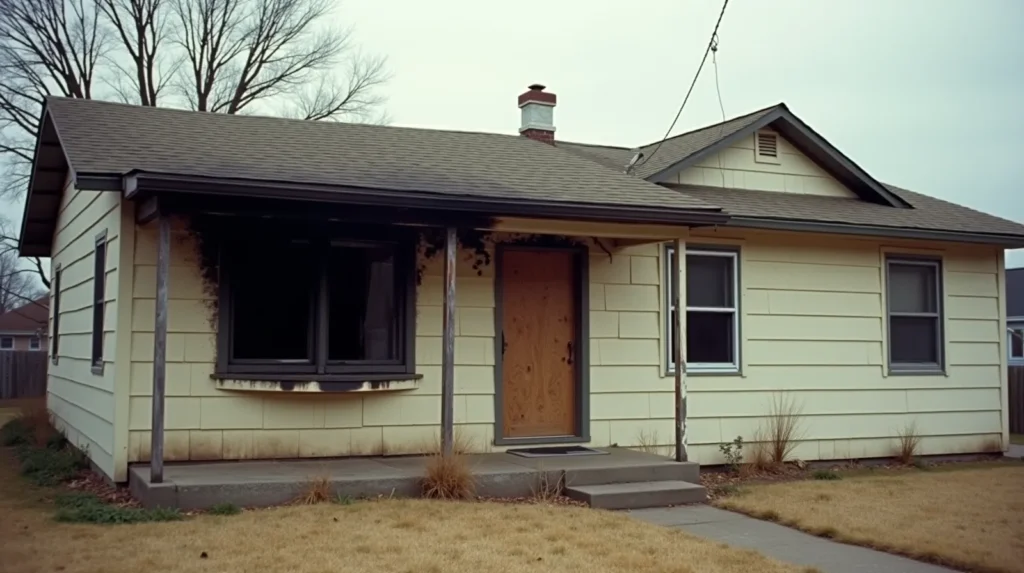
What a Fire-Damaged House Is Actually Worth
A fire-damaged house sells for what the land is worth, plus whatever the structure still contributes, minus what it costs the next owner to make it habitable. That last number is the one that surprises people. Demolition and rebuild costs are carried by whoever buys it, so they come straight off your price.
That is the whole valuation in one paragraph. Everything below is detail.
The short version
You can sell a fire-damaged house as-is, in any condition, without repairing anything. In most cases you keep your insurance payout — but only if you settle the claim correctly before you sell. And if the damage is cosmetic and you are not in a hurry, a regular sale will net you more than we will.
Do I Keep the Insurance Money If I Sell the House?
Usually yes, but the timing decides it. This is the question that costs people the most money and almost nobody answers it plainly.
Your claim and your house are two separate assets. The claim is a contract between you and your insurer for a loss that already happened. The house is property. Selling the house does not automatically hand the claim to the buyer.
Three things change that:
- A mortgage. If you still owe, your lender is almost always named on the claim cheque. They can require the money go toward repairs, or toward the loan balance. Call your servicer before you agree to anything.
- Replacement cost vs actual cash value. Replacement-cost policies often pay the depreciated amount first and hold back the rest until repairs are actually done. Sell without repairing and that holdback can simply never arrive.
- What the contract says. Some buyers ask you to assign the claim to them as part of the deal. That is not automatically bad — but it is a real thing of value, and it should be priced, not slipped in.
Settle or fully understand your claim before you sign anything. A buyer who pressures you to skip that step is telling you something about themselves.
Your Three Real Options
There are only three, and they trade the same three things: time, money, and certainty.
| Option | Who pays for repairs | Timeline | Nets you most when… |
| Restore it, then list | You, up front | Months — contractors, permits, then a normal listing | Damage is contained, you have cash to float the work, and you can wait |
| List it as-is with an agent | The buyer | Long — most mortgage lenders will not finance a fire-damaged house, so your buyer pool is cash investors anyway | The house is in a strong location and you can wait out a smaller pool |
| Sell direct to a cash buyer | The buyer | Days | You need certainty, or the carrying costs are bleeding you |
Notice the second row. Listing a fire-damaged house on the open market sounds like the middle path, but conventional and FHA financing generally will not close on a house with active fire damage. So an agent listing ends up marketing to the same cash investors you could approach directly — except you also pay a commission for the introduction.
When You Should Not Sell to Us
If the fire was contained — a kitchen, a garage, one room — the structure is sound, your insurance is paying, and you are not on a deadline, restore it and sell it normally. You will net more. Possibly a lot more.
We are the right answer when the numbers stop working: the rebuild costs more than the finished house is worth, the claim has been denied, you are carrying a mortgage on a house you cannot live in, or you simply do not want to project-manage a rebuild from another city. That is a real set of circumstances, and it is the only set we are better at than an agent.
Any buyer who tells you selling to them is always the smart move is selling you something. It is not always the smart move.
What You Legally Have to Disclose
All of it. Every state requires you to disclose known material defects, and a fire is the definition of material. Past fire damage generally has to be disclosed even after a full professional restoration, because it affects what a future buyer is buying.
This is another reason as-is sales are simpler here. We are buying the house knowing exactly what happened to it. There is no inspection contingency to fail, and no discovery later that unwinds the deal.
Smoke Damage Is the Part People Underestimate
Fire damage is visible. Smoke damage is the expensive one.
Smoke travels through the whole house — it gets into wall cavities, HVAC ductwork, insulation, and subfloor. A fire that physically burned one room can contaminate a whole structure, and the remediation bill routinely dwarfs what the flames themselves cost. Then there is water damage from putting the fire out, which starts growing mould within days.
This is why a contractor’s rebuild quote and a cash offer can look so far apart. The quote usually prices what burned. The offer prices what has to be gutted.
How Our Process Works
You put the address in. We look at the property, the damage, and what the finished house would be worth in that market. You get a number within 24 hours, and if it works, you pick the closing date — typically 7 to 14 days out. No repairs, no cleaning, no commission, no closing costs.
We have bought more than 100 houses. Some of them nobody else wanted to touch.
One thing we will say plainly, because our own industry has earned the suspicion: sometimes we buy the house ourselves, and sometimes the right buyer for it is someone else in our network and we bring them to you instead. We will tell you which it is. What never changes is that nobody gives you a high number just to tie the house up. Watch out for buyers who give a high offer, tie up your house under contract, then “re-negotiate” after an inspection they always intended to run. That is a bait-and-switch, it is common in this business, and it costs you weeks you may not have.
Common Questions
Can I sell a house that has already burned down completely?
Yes. At that point you are selling a lot with debris on it, and the offer reflects demolition and haul-off costs. It is still a sale, and it still ends the carrying costs.
Will I get less than market value?
Yes, compared with a fully restored house sold on the open market. The gap is the rebuild cost plus the risk of it. What you get instead is speed and certainty, and you avoid the commission, the repairs, and months of holding a house you cannot use. Whether that trade is worth it depends entirely on your situation — see the section above on when not to sell to us.
What if the insurance company denied my claim?
You can still sell. A denial changes your economics, not your ownership. It usually makes a cash sale more attractive, because the money to rebuild is not coming.
Do I need to clean the house out first?
No. Take what you want to keep and leave the rest.
How fast can this actually close?
Offer within 24 hours of getting the address. Closing in 7 to 14 days, on a date you choose. If you need longer, that is fine too — the date is yours.
Where You Are Matters
The timeline pressure on a fire-damaged house is rarely the fire. It is what is running alongside it — a mortgage, a foreclosure clock, an estate.
That clock runs at very different speeds depending on the state. Tennessee and Texas are non-judicial foreclosure states, where a lender can move to a trustee’s sale without going to court, and the whole thing can be over in a matter of weeks. Florida is judicial — the lender has to sue, which takes far longer and gives you more room. If you are behind on payments on a house you cannot live in, which state you are in changes what “urgent” means.
We buy nationwide. If you are dealing with a fire on top of something else, these help:
- Facing foreclosure: how to sell before it is too late
- Inherited a house you do not want
- Selling as-is: no repairs, no cleaning
- Cash buyer vs agent vs iBuyer, compared
Put your address in at the top of this page and you will have a number tomorrow. Or call us on (615) 780-7349 and ask whatever you want first.
Keep reading
- Can You Sell a House With Plumbing Problems?
- How to Sell a House As-Is: What the Discount Really Is
- Selling a House With Title Problems
- Selling a House With a Reverse Mortgage
- Sell Your House Without a Realtor: Your Two Real Options
- Can I Sell My House During a Divorce?
Ready for a number? Get your cash offer or call (615) 780-7349.