


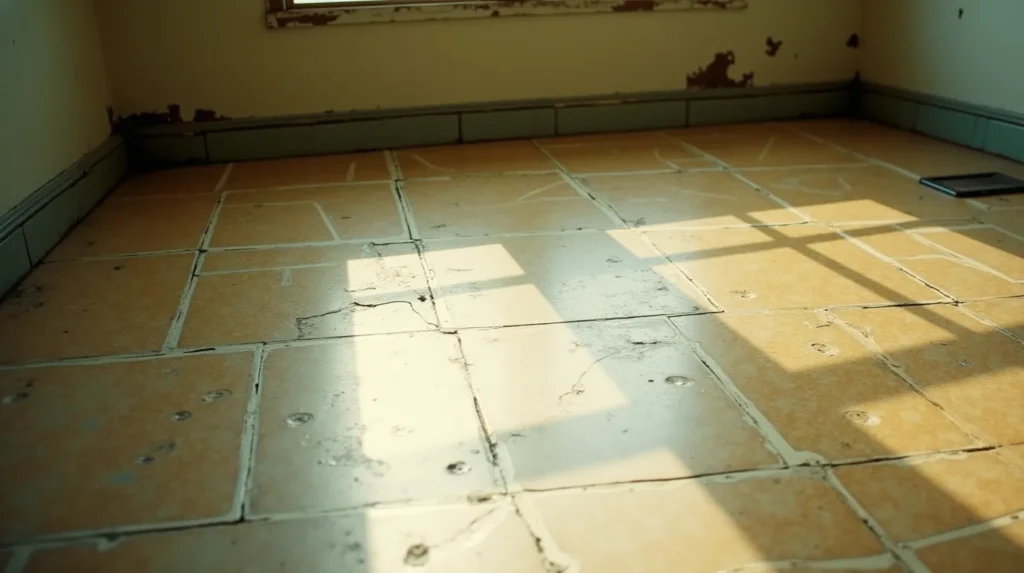
Your buyer’s inspector found asbestos. Or maybe you already knew — the house is from 1967, the vinyl floor tiles have been there since the Nixon administration, and you’ve been leaving them alone. Either way, you now have a disclosure obligation and, depending on your buyer, a problem.
In most cases, the problem isn’t legal. It’s financial. Asbestos doesn’t prevent a sale. It prevents a financed sale.
The short version: You can legally sell a house with asbestos in Tennessee, Texas, and Florida — state law requires disclosure, but the sale itself is permitted. The obstacle is that FHA and VA lenders won’t fund a home with friable asbestos present, which removes the majority of buyers. Cash buyers buy as-is. The abatement cost factors into the offer price. There’s no lender to satisfy, no underwriter adding conditions, no renegotiation demand after inspection.
Where asbestos hides in pre-1980 homes
Asbestos wasn’t a niche material. Before 1980, it was standard in dozens of building products because it’s cheap, fireproof, and durable. The places we see it most often in older Tennessee and Florida homes:
- Vinyl floor tiles and the mastic adhesive beneath them
- Popcorn ceiling texture (spray-applied acoustic coating, common 1950s–1970s)
- Pipe insulation and duct wrap
- Joint compound and drywall tape in some pre-1977 products
- Exterior transite board siding (a fiber-cement product used in mid-century homes)
- Roof shingles and felt underlayment
Finding it in one area doesn’t mean it’s everywhere. An industrial hygienist samples each suspect material separately. Each one gets a separate test result.
Friable vs. non-friable: the distinction lenders actually use
The EPA draws a sharp line between friable and non-friable asbestos. Friable means it can be crumbled by hand pressure — deteriorating pipe wrap, damaged acoustic ceiling texture. Non-friable means it’s bound in a solid matrix and unlikely to release fibers under normal use — intact vinyl floor tiles, undisturbed transite siding.
That line matters because FHA’s Minimum Property Standards, set out in HUD Handbook 4000.1, require that friable asbestos be abated before a loan closes. Non-friable asbestos in good condition may be accepted with encapsulation. The appraiser flags it; the underwriter decides case by case.
VA appraisals follow similar requirements under VA Pamphlet 26-7. If the appraiser notes asbestos as a health and safety concern, the lender conditions the loan on remediation before closing.
What disclosure requires in TN, TX, and FL
Selling without disclosure isn’t a viable option in any of these states. Here’s what each statute actually says.
Tennessee. TCA § 66-5-202 requires sellers to disclose known material defects, including hazardous substances, on the Residential Property Condition Disclosure form. Asbestos you know about is a known hazard. “I didn’t test” is a reasonable answer if true — but “I didn’t know” after an inspection report with your name on it is not.
Texas. Texas Property Code § 5.008(b) lists asbestos-containing materials directly on the Seller’s Disclosure Notice (TREC Form OP-H). You disclose whether asbestos is known or suspected to be present. If you had a test done, the result belongs on the disclosure.
Florida. Florida Statute § 689.261 imposes a general duty to disclose known facts that materially affect the value of residential property and are not readily observable. Asbestos qualifies. Withholding known environmental hazards carries fraud exposure under Florida common law as well.
Disclosing asbestos does not kill a sale. It narrows the buyer pool — specifically, it removes buyers whose lender requires a clear environmental report.
Abatement vs. encapsulation: what each costs and who will accept which
Abatement means physical removal by an EPA-licensed contractor, followed by a clearance air test from a certified industrial hygienist. Scope drives cost. Removing vinyl floor tiles in one room might run $2,000 to $5,000. Stripping pipe insulation throughout a basement or pulling an acoustic ceiling on a full house can reach $20,000 or more. Get a written estimate — the range is wide.
Encapsulation means sealing the material in place so fibers can’t become airborne — painting over intact popcorn ceiling, laying new flooring over undisturbed tiles. It’s cheaper, and for non-friable material in good condition it can sometimes satisfy FHA. It does not satisfy FHA for friable material.
After either approach, you need a written clearance report from a certified industrial hygienist. That’s the document the lender actually reviews.
The math some sellers work through: if abatement costs $15,000 and the house would otherwise sell for $275,000, is it worth doing? Sometimes yes. If the house also needs a new roof, HVAC work, and foundation repairs, the stack adds up fast, and a cash offer on the house as-is may net more after contractor costs, carrying time, and commission are factored out.
Why financed buyers can’t proceed on most asbestos-present sales
A financed buyer’s purchase is contingent on their lender’s appraisal and underwriting. The appraiser is required to note health and safety issues. Friable asbestos is one of them. Once it’s flagged, the underwriter adds a condition: proof of remediation before funding.
That condition creates a renegotiation. The buyer asks you to pay for abatement, credit them the cost at closing, or lower the price enough to cover it themselves. You agree, counter, or lose the buyer. Many sellers work through this with limited asbestos. Many don’t — particularly on older homes where asbestos is widespread, or where the buyer is on a timeline that doesn’t accommodate six weeks of contractor scheduling and clearance testing.
USDA loans carry identical requirements. Only conventional buyers putting 20% or more down, with no government-backed financing, can sometimes proceed without remediation — if they sign off in writing and accept the condition. That’s a narrower market than most sellers expect.
The cash buyer path
We buy houses as-is, including with asbestos present. No lender involved. No appraiser adding conditions to a file. No underwriting hold on environmental.
Here’s what actually happens. You give us the address. We look at the property — including any inspection reports or asbestos test results you already have. We build the estimated abatement cost into our calculation of what the house is worth to us and offer accordingly. You receive a number within 24 hours. You decide whether it works for your situation. No obligation either way.
We buy directly and, where we’re not the right buyer, we’ll bring one from our network. Either way, you deal with one point of contact, not a daisy chain.
We’ve bought more than 100 houses. Some had environmental conditions that made the conventional market impractical. That’s not unusual in a housing stock where a large share of the inventory was built before 1980.
Closing in 7 to 14 days if you need it. You pick the date. No agent commission, no closing costs on your side, no repair credits demanded.
When you should not sell to us
If the asbestos is limited to one small area — a single room of intact floor tile, for example — and it’s non-friable and in good condition, targeted abatement may be both practical and affordable. Complete the abatement, get the clearance report, and list the house with an agent at full market value. You’ll net more than a cash offer in that scenario, because the cash offer price reflects abatement cost and holding risk that you’ve already eliminated.
The same logic applies if you have two months or more, the house is in solid shape otherwise, and the only complication is a contained asbestos issue. A few thousand dollars of abatement on non-friable material, done properly, reopens the full financed buyer pool.
We’re the right call when abatement cost is high relative to home value, when other deferred maintenance layers on top of it, when you’re on a timeline that doesn’t allow for contractor scheduling, or when a previous escrow already fell apart on the asbestos condition and you’d rather have certainty this time.
Straight answers
Can I sell a house with asbestos in Tennessee without disclosing it?
No. TCA § 66-5-202 requires disclosure of known hazardous substances on the mandatory Residential Property Condition Disclosure form. Selling without disclosure after you’re aware of asbestos is legal exposure, not a loophole.
Will an FHA buyer be able to purchase my house if it has asbestos?
Not if there’s friable asbestos present. HUD Handbook 4000.1 requires friable asbestos to be abated before an FHA loan closes. The appraiser will note it. The underwriter will condition on it.
Does encapsulation satisfy FHA requirements?
For non-friable material in documented good condition, sometimes. For friable asbestos, no — FHA requires abatement and a clearance air test. The underwriter makes the call case by case, but don’t plan on encapsulation solving a friable situation.
How much does asbestos abatement cost?
Scope determines it entirely. Limited floor tile removal in one area might run $2,000–$5,000. Full-house pipe insulation or ceiling abatement can reach $20,000 or more. Get a written estimate from an EPA-licensed contractor before making decisions. Costs vary significantly by region and scope.
Can a cash buyer purchase my house with asbestos?
Yes. Cash buyers don’t have a lender requiring a clear environmental report. We factor condition into the offer and buy as-is. If you want to know what that number looks like for your property, give us a call at (615) 780-7349 or drop your address below.
We buy houses as-is in any condition — mold, water damage, fire damage, or environmental conditions like asbestos that make the conventional market difficult. One call, one offer, one closing.
Keep reading
- Sell My House Fast in Gallatin, TN | Cash Offer in 24 Hours
- Can You Sell a House That’s in a Trust?
- Sell a Fire Damaged House Fast for Cash
- Sell My House Fast Converse TX
- Sell My House Fast Spokane Valley WA
- Sell Your House Before Foreclosure
Ready for a number? Get your cash offer or call (615) 780-7349.