


The short version
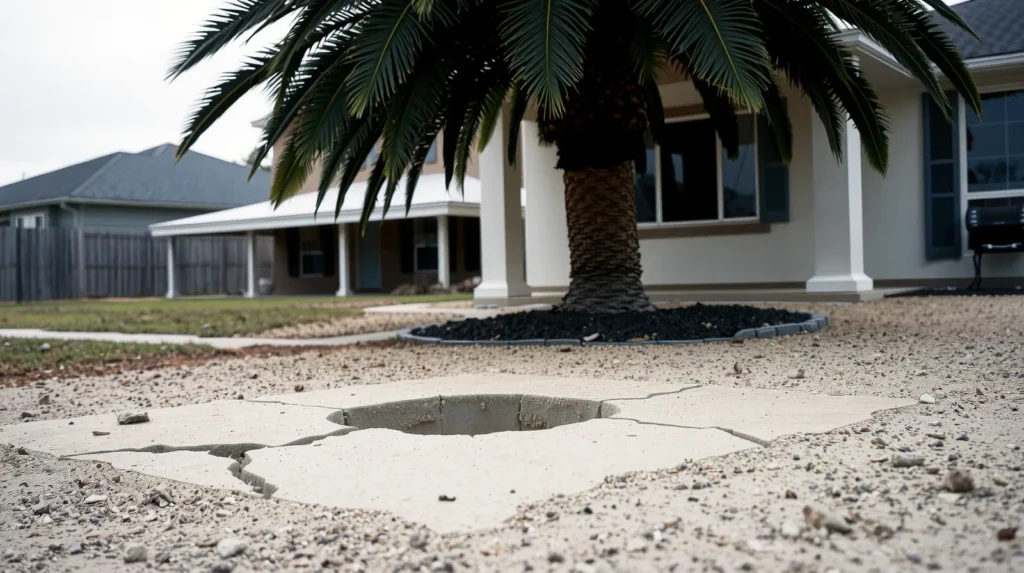
You can sell a house with a sinkhole — repaired or not. An active sinkhole blocks every financed buyer because lenders require structural clearance before funding. Cash buyers skip the appraisal entirely. If the sinkhole is already remediated and documented, you have more options, but the claim history follows the property for seven years and continues to limit your buyer pool.
A sinkhole on the property ends any deal with a financed buyer until remediation is documented and cleared. That is not a negotiating position — it is how FHA, VA, and conventional appraisals work. Once you understand that, the options are fewer than you hoped but clearer than they seem.
We’ve bought more than 100 houses. Some of them had sinkhole history. What follows is what we know from sitting at those tables.
Three situations, three different paths
Active sinkhole, no remediation. Financing is off the table. Under HUD 4000.1 §II.A.3.b(ii), a property must not be subject to “unacceptable soil conditions” or “subsidence.” An active sinkhole triggers a repair condition — the lender holds the loan until a licensed professional geologist or engineer documents the remediation and clears the structure. Without that documentation, no financed buyer can close. Your realistic options are cash buyers only.
Remediated sinkhole. This is better, but the claim stays in the CLUE database — an insurance claims history system shared across all carriers for seven years. Every buyer’s insurer sees it. In Florida, that often means private carriers either add a sinkhole endorsement surcharge of $2,000 to $10,000 annually or decline to write coverage at all. Without an insurance binder, a financed buyer cannot close — regardless of the physical repair. The discount on remediated sinkhole properties in active Florida sinkhole markets typically runs 10% to 20% below comparable homes that carry no sinkhole history.
Suspected sinkhole, no claim filed yet. In Florida, sellers are legally required to disclose known sinkhole activity under Florida Statute § 689.261. In active sinkhole counties — Hernando, Pasco, Hillsborough, Polk, Pinellas — buyers routinely order sinkhole inspections. If activity is found after a contract is signed, most lenders issue a repair condition and most financed buyers walk. Waiting does not change the disclosure obligation and does not improve your position.
Why Florida is where this problem is most acute
Florida accounts for the majority of sinkhole insurance claims in the United States. The reason is geology: limestone and dolomite underlie most of the state, and rainwater dissolves them over time. In Spring Hill, Land O’ Lakes, New Port Richey, Brooksville, Wesley Chapel, and the surrounding Hernando and Pasco County areas, sinkhole activity is routine enough that buyers specifically pay for sinkhole investigations before making an offer. It is not a surprise disclosure in those markets — it is expected due diligence.
What Florida insurance law requires. Florida Statute § 627.706 historically required every insurer writing residential coverage in Florida to offer sinkhole loss coverage. The 2011 legislative reforms and 2022’s Senate Bill 2-D substantially changed what that means in practice. Citizens Insurance no longer writes new sinkhole endorsements in Hernando, Pasco, Hillsborough, Pinellas, and Polk counties — precisely the counties with the highest activity. Private carriers that do write sinkhole endorsements in those counties often price them at $2,000 to $10,000 annually for a property with no prior claims, and higher for a property with a claim on record. No insurance binder means no mortgage commitment.
The distinction between sinkhole loss and ground cover collapse. Florida Statute § 627.7073 draws a line between these two. Ground cover collapse — sudden, catastrophic surface opening — is typically covered under standard homeowners policies. Sinkhole loss — the slow, subsurface kind confirmed by a licensed professional geologist using specific testing methods — requires the separate sinkhole endorsement. Most properties in sinkhole-active areas have the slow kind. If a buyer’s insurer declines to write the endorsement, the financed deal ends.
Disclosure obligation. Under § 689.261, sellers must disclose known sinkhole activity. “Known” means you have an engineering or geological report, you filed an insurance claim, or you have visible surface evidence of subsidence. A prior sinkhole insurance claim is searchable by any title company. Selling without disclosure when you have actual knowledge creates material misrepresentation liability. A cash buyer who reviews the documentation before purchase understands what they are taking on — that is different from concealment.
What remediation actually costs
Grouting — filling subsurface voids with concrete or expanding polyurethane — is the most common residential repair method. Cost ranges:
- Shallow, small void with no structural impact: $10,000–$25,000
- Mid-size void requiring compaction grouting under the foundation: $25,000–$60,000
- Severe case with foundation reconstruction: $100,000–$200,000 or more
After remediation, expect a discount on resale anyway. In active sinkhole markets in Florida, remediated properties sell for roughly 10% below comparable homes without sinkhole history, even with a clean engineering report. The claim history persists in CLUE. On a $350,000 home, that 10% discount is $35,000.
The math on whether to remediate and list depends on the repair cost, the post-repair discount, how long you can carry the property while repairs are done, and whether you have a hard deadline. For many sellers — especially those managing an estate, facing foreclosure, or unable to get insurance on a vacant property with active sinkhole activity — waiting three to six months for repairs is not an option.
How a cash sale works on a sinkhole property
A cash buyer does not use a lender, does not need an appraisal, and does not need an insurance binder to close. That eliminates the three barriers that stop financed buyers cold on sinkhole properties.
Here is what happens after you submit your address:
- We receive the property details, including what you know about sinkhole history. No need to hide it.
- We make a cash offer within 24 hours — on the property as it sits.
- If you accept, we schedule a walkthrough. On sinkhole properties, we may want to review any existing engineering reports or prior claims documentation to understand what we are taking on. This is not a barrier; it is how we price the offer honestly.
- We set a closing date. Typically 7 to 14 days. You pick the date.
- No commissions, no closing costs, no repair expenses on your end.
We buy houses directly, and where we’re not the right buyer we’ll bring you one who is. Either way, you have an offer within 24 hours of submitting the address.
Your real options compared
| Path | Who can buy | Expected discount | Timeline to close | Your out-of-pocket |
|---|---|---|---|---|
| Remediate, then list with agent | Financed and cash buyers | 10%–20% below market even after repair | 3–9 months (repairs + listing + closing) | $10k–$150k+ in repairs; 5%–6% agent commission; carrying costs |
| List as-is with an agent | Cash buyers only (financed locked out) | 40%–50% below market | Unpredictable — limited buyer pool | Agent commission on a lower price |
| Cash sale direct | Cash buyer | Below market, priced for condition | 7–14 days | No fees, no commission, no repairs |
When a cash sale is not the right answer
If the sinkhole is fully remediated and documented, you have three to six months to work with, and you are selling in a county where sinkhole endorsements are available at reasonable cost, listing with a real estate agent on the open market is worth considering. You will still take a discount in active sinkhole markets, but the buyer pool is larger, and on a $350,000 home you might net $20,000 to $40,000 more than a cash sale would produce.
A cash sale makes more sense when:
- The sinkhole is unrepaired and active — you have no financed buyers regardless
- You have a hard deadline: foreclosure auction, estate settlement, relocation start date
- The property is in Hernando, Pasco, Hillsborough, Polk, or Pinellas County in Florida, where sinkhole endorsements are unavailable from Citizens and cost-prohibitive from private carriers
- The property is vacant — vacant homes with active sinkhole activity are expensive or impossible to insure, and every month carries real cost
Tennessee and Texas: sinkhole activity outside Florida
Tennessee. East Tennessee sits on karst limestone bedrock. Sinkhole formation is documented in Monroe, Sequatchie, Grundy, Van Buren, White, and Warren counties. Activity is less common and less insurance-focused than Florida, but the disclosure obligation is the same: Tennessee’s seller disclosure statute (TCA § 66-5-202) requires disclosure of all known material defects, and a known sinkhole qualifies. The practical barrier in Tennessee is structural rather than insurance-driven — though the FHA and VA financing barriers under HUD 4000.1 apply equally here as they do in Florida.
Texas. Sinkhole activity in Texas is concentrated in the Permian Basin — Wink and Reeves County — from salt dissolution rather than limestone dissolution. The two sinkholes near Wink (Wink Sink 1, discovered 1980; Wink Sink 2, discovered 2002, and still growing) have received geologic attention, but residential sinkhole claims in Texas are uncommon compared to Florida. TREC Form OP-H Section 5 covers soil and drainage conditions and requires disclosure; Texas Property Code § 5.008 applies to residential transactions.
Questions sellers in sinkhole situations actually ask
Can I sell a sinkhole house in Florida without disclosing it?
No. Florida Statute § 689.261 requires sellers to disclose known sinkhole activity. A prior insurance claim is discoverable by any title company through CLUE. Concealing known sinkhole activity when you have actual knowledge creates material misrepresentation liability.
What happens if a sinkhole is found during inspection after we’ve signed a contract?
Most standard purchase agreements carry an inspection contingency. If a sinkhole is found and the buyer is financing, the lender will typically issue a repair condition — the deal is suspended until remediation is documented. Most financed buyers walk at that point or renegotiate price significantly. A cash buyer has more flexibility to work through it.
Does homeowners insurance cover sinkhole damage in Florida?
Florida Statute § 627.706 historically required insurers to offer sinkhole coverage. After 2011 reforms and 2022’s SB 2-D changes, Citizens Insurance no longer writes new sinkhole endorsements in the highest-activity counties. Private carriers vary significantly. Standard homeowners policies distinguish between “ground cover collapse” (sudden — usually covered) and “sinkhole loss” (slow, subsurface — requires the separate endorsement). Check your policy’s definitions. Outside Florida, most states treat sinkhole loss as a standard exclusion.
How long does sinkhole remediation take in Florida?
A standard grouting project for a residential sinkhole typically takes two to six weeks from site mobilization to completion. Engineering certification and final sign-off usually follow within two to four weeks. Realistically, you are looking at two to three months before the property is ready to market with documentation in hand — assuming no complications with permits or scope expansion.
One step from here
Submit the address. We’ll have a cash offer within 24 hours — no obligation, no pressure, and no requirement to repair anything first. If selling to a cash buyer is not the right answer for your situation, we’ll tell you directly.
For the Tampa Bay area — where sinkhole activity is heaviest — see our Tampa cash home buyers page. For statewide Florida coverage, see We Buy Houses Florida. If there is foundation damage on top of the sinkhole, our foundation problems page covers the overlap. For the general mechanics of selling as-is, see how to sell your house as-is for cash.
Keep reading
- Sell My House Fast Augusta, GA
- Sell My House Fast in Racine, WI — Cash Offer in 24 Hours
- We Buy Houses Washington State
- Sell My House Fast in Atlanta, GA — Cash Offer in 24 Hours
- Selling a House With a Lien on It
- Sell My House Fast in Cottage Grove MN — 24-Hour Cash Offer
Ready for a number? Get your cash offer or call (615) 780-7349.