


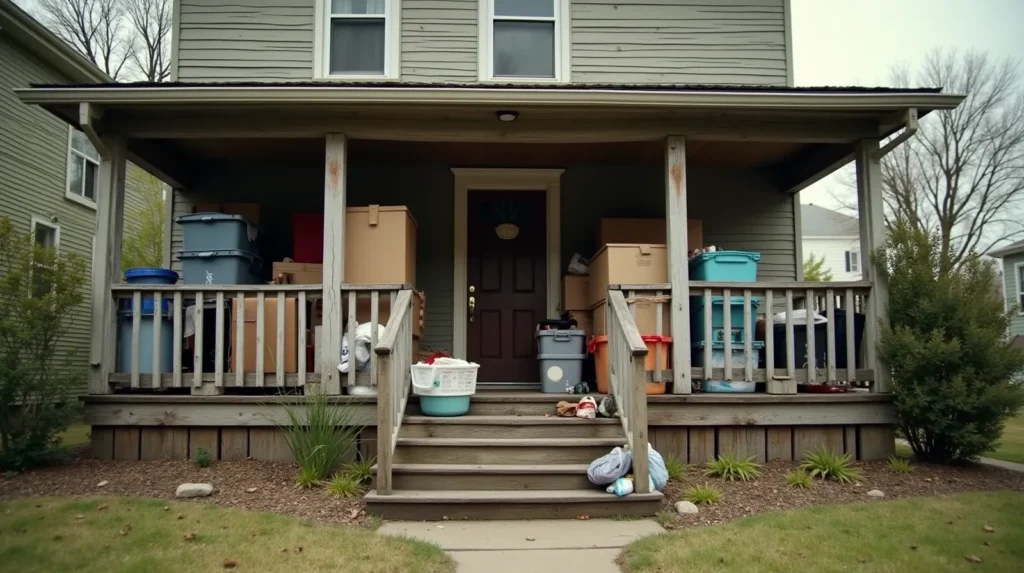
You don’t have to clean it out first. That’s the short answer.
If you inherited a house so full you can’t open the bedroom doors, or if you’re selling your own home after years of accumulation, the most common advice you’ll hear is the most expensive: clean it, repair it, then list it with an agent. That’s the right path for some sellers. It’s the wrong one for others.
This page explains both paths honestly — the real costs of each, the legal requirements that apply in Tennessee regardless of how you sell, and who should not sell to a cash buyer.
The short version: You can sell a hoarder house as-is to a cash buyer. No cleanout, no repairs, no agent fees. You’ll have an offer within 24 hours of submitting the address. The tradeoff is a lower sale price than a fully cleaned and repaired listing. If you have the time and the upfront cash for cleanup, a traditional sale will net more. If you don’t, selling as-is is a real option with a defined process.
The two paths — what each one actually costs
Path 1: Clean it out, then sell with an agent
Most of the cost in this path comes before you ever list. Professional hoarder cleanout and junk removal runs roughly:
- Light accumulation (one to two rooms): $1,000–$2,500
- Moderate hoarding (most of the house, stacked but walkable): $3,000–$8,000
- Severe hoarding (floor-to-ceiling, structural access blocked): $8,000–$20,000+
That’s before you find what’s underneath. Hoarder homes frequently have deferred maintenance that’s been hidden for years — mold from trapped moisture, pest damage behind walls and under floors, plumbing fixtures that went unfixed because access was blocked, electrical problems from extension cords run as permanent wiring. Finding the repairs after cleanup can add another $5,000 to $30,000 depending on what the walls have been hiding.
Add agent commissions — typically 5–6% of the sale price — and a $200,000 home generates $10,000–$12,000 in fees on top of the cleanup cost.
The upside: a cleaned, repaired, and properly listed home sells closer to its full market value. If the bones are sound and the market is active, the math can favor this path even with the upfront costs.
Path 2: Sell as-is to a cash buyer
A cash buyer makes an offer on the house in its current condition. Nothing moves out before the offer, and nothing has to move out before closing — you can leave everything exactly where it is.
The offer reflects the condition. If a cleaned and repaired version of the house would sell for $200,000 and we estimate $18,000 in cleanup and repairs, our number will be lower. That discount is real, and any cash buyer claiming otherwise is not being straight with you.
Neither path is a scam. They’re different trades — market value in exchange for time and upfront money, versus speed and certainty in exchange for a lower number.
| Factor | Clean & list with agent | Sell as-is for cash |
|---|---|---|
| Upfront cost | $5,000–$30,000+ (cleanup + repairs) | None |
| Agent commission | 5–6% of sale price | None |
| Timeline to close | 3–6 months | 7–14 days |
| Final sale price | Closer to market value | Discounted for condition |
| Cleanup required | Yes — before listing | No — leave everything |
| Financing risk | Buyer financing can fall through | Cash — no financing contingency |
Why conventional buyers often can’t finance a hoarder house regardless
FHA, VA, and USDA loans all require the property to meet minimum property standards — clear egress from every bedroom, accessible utilities, no immediate health or safety hazards. A heavily filled home typically fails that inspection. So does a home with visible mold or evidence of active pest infestation.
This means even if you clean a hoarder house to “livable,” the traditional buyer pool may still be limited to cash buyers. The inspection can surface what the cleanup revealed. Many sellers start on path 1 and end up selling to a cash buyer anyway — after spending $10,000–$15,000 on cleanup first.
Knowing this upfront changes the math. If you’re already likely to end up at a cash buyer, the question is whether the cleanup cost produces a meaningfully better offer. In some cases it does. In others, the difference doesn’t justify the spend.
Tennessee disclosure requirements — what you’re legally required to say
Tennessee’s Residential Property Disclosure Act (T.C.A. § 66-5-202) requires sellers to disclose known material defects. Selling as-is does not exempt you from disclosure — it means the buyer accepts the condition, not that you can hide what you know.
Hoarder homes generate a specific set of disclosable defects that sellers often don’t discover until the rooms are clear:
- Mold — trapped moisture under accumulated items, especially against exterior walls or near plumbing, creates mold conditions that often go undetected for years. If you know it’s there, disclose it.
- Structural damage — floors weakened by sustained weight, ceilings with water infiltration that went unaddressed, load-bearing compromised by long-term moisture
- Pest activity — rodent and insect infestations are common in homes where food was stored openly and walls were inaccessible for years. Prior infestations that left physical damage are material defects.
- Plumbing and electrical — any known problems with systems that were inaccessible for repair during the accumulation period
Failing to disclose known defects can expose you to claims after closing. If you sell to us, we’ll ask what you know — not to use it against you, but because we’d rather price the real condition accurately before signing than renegotiate after.
Hoarder houses and inherited estates — a common overlap
Many hoarder houses reach the market through an estate. A parent or relative accumulated for decades; the heirs inherit the property and the contents simultaneously. If you’re in this situation, most of the same rules apply — and if the estate is still in probate, a sale is often still possible in Tennessee with court approval.
If you’ve already completed probate and the property transferred to you, the process is identical to any other sale. If you’re still working through the estate, our page on selling an inherited house covers the probate angle in more detail, including what typically needs court sign-off.
What we look at when making an offer
The walkthrough is free. Here’s what determines the number:
Location and lot value — a hoarder house on a solid lot in a Sumner County suburb prices differently than the same condition on a weaker lot in a softer market. The lot value is largely unchanged by what’s inside.
What you tell us — before we walk through, we’ll ask about the approximate level of fill, whether there are known mold or pest issues, and whether there’s been any recent structural work. This gives us a starting estimate before we arrive.
What the walkthrough finds — we look at the roof, foundation, floors, and any visible moisture or pest evidence. If we find something significant that wasn’t in the description, we’ll tell you what it is and what it changes before revising the offer — not at closing.
Comparable as-is sales — what similar distressed properties in that zip code have actually closed for, not what listed homes are asking.
The offer we give you on the phone may adjust after the walkthrough if the condition differs from the description. That adjustment happens before you sign anything.
How the sale works if you accept
Here’s the sequence after you give us the address:
- We review county records and anything you tell us about the condition
- We call you within 24 hours with a cash offer — no obligation to accept
- If you accept, we schedule a walkthrough, usually within a few days
- If the walkthrough matches the description, we move to closing
- You pick the closing date — as fast as 7 days, or longer if you need time
- At closing, you receive the cash. You leave whatever you want inside. We handle the cleanout.
We buy houses directly in most markets. Where we’re not the right direct buyer, we bring in a buyer from our network — the offer process and timeline work the same either way. No commissions, no fees, no closing costs taken from your proceeds.
Many of the same hoarder-house challenges appear in other as-is situations we regularly handle — houses with code violations and fire-damaged properties both involve conditions that rule out conventional buyers and require the same kind of as-is cash process.
When you should not sell to us
If all of these are true:
- The house has good structure — solid floors, a roof that isn’t at end of life, no major foundation issues
- You have $10,000–$20,000 available to fund cleanup and basic repairs upfront
- You have 3–5 months to get it on the market and wait for a buyer
- The local market for that price range is active — homes are moving within 60 days
— a traditional sale will almost certainly net you more money than a cash offer, even after cleanup costs. A cleaned and reasonably prepared home in Nashville, Murfreesboro, or a Sumner County neighborhood with strong comparable sales will get offers near market value. Our offer won’t match that.
This is also true if the hoarding was relatively contained — one badly cluttered room, manageable accumulation throughout, nothing structural. That house may just need a dumpster bin and a weekend. A cash buyer discount isn’t the right move for a house you can clean with a Saturday afternoon.
We’re the right call when the time, money, or emotional weight of a traditional sale makes the discount worth it. Some sellers do the math and decide yes. Others decide no. Both are rational decisions, and we’ll tell you honestly which situation you’re in.
If you’re also considering selling without an agent but want more than just the as-is cash route, read our breakdown of selling without a realtor — it covers the FSBO path alongside the cash buyer option.
Straight answers
Do I have to remove anything before you make the offer?
No. Give us the address and a rough sense of how full the house is. That’s enough to start.
Do I have to remove anything before closing?
No. You can leave everything exactly as it is. We take the property with the contents.
Will mold or pest problems end the deal?
No — but we need to know. We price for those conditions. What creates problems is a significant undisclosed issue found at closing, which is why we ask upfront.
Can I sell a hoarder house that’s still in probate?
In many cases, yes, with court approval. The specifics depend on how far along the estate is. Call us and we’ll tell you what we know about your situation.
What if I already got a cash offer from someone else?
Call us at (615) 780-7349. We’ll give you our number and you can compare them directly. No pressure.
Do you buy outside Tennessee?
Yes, nationwide. We buy directly where we can and bring in a local buyer from our network where we can’t. The process is the same.
One step
Give us the address. We’ll call back within 24 hours with a cash number — no cleanup required before then, no obligation after. Use the form on this page or call us directly at (615) 780-7349.