


What federal law actually requires — and what it doesn’t
If your house was built before 1978, it almost certainly has lead-based paint somewhere. That is not a reason you cannot sell. It is a legal obligation that kicks in the moment you list the property — and a practical problem that can kill a financed sale at the appraisal stage.
Short version: Federal law requires you to disclose known lead paint to any buyer, including a cash buyer. Intact, well-adhered lead paint does not block most sales. Deteriorating lead paint — peeling, chipping, chalking — fails FHA and VA minimum property standards. That shuts out most financed buyers. If you have deteriorating paint and don’t want to remediate it, a cash buyer is the direct path to closing.
The federal disclosure rule — it applies to every sale
The Residential Lead-Based Paint Hazard Reduction Act (42 U.S.C. § 4852d) requires sellers of pre-1978 residential property to:
- Disclose any known lead-based paint or lead hazards in writing
- Give the buyer the EPA pamphlet Protect Your Family from Lead in Your Home
- Allow a 10-day window for a lead inspection or risk assessment — the buyer can waive this in writing, but you must offer it
This applies whether you sell through an agent, list on the MLS, or sell the property as-is directly to a cash buyer. There is no exemption for as-is sales. If you know lead paint is present, you disclose it. If you don’t know, you say so — but you still provide the pamphlet and the inspection period.
Failing to disclose carries civil penalties up to $22,973 per violation and potential criminal liability under EPA 40 CFR Part 745. The disclosure is not optional and not something a clean as-is clause gets around.
The difference between intact and deteriorating lead paint
Here is the thing most sellers don’t know: the disclosure requirement and the sale-blocking problem are two separate issues.
Disclosing lead paint to a buyer does not, by itself, stop the sale. What stops the sale is deteriorating lead paint — and then only when the buyer is financing with an FHA or VA loan.
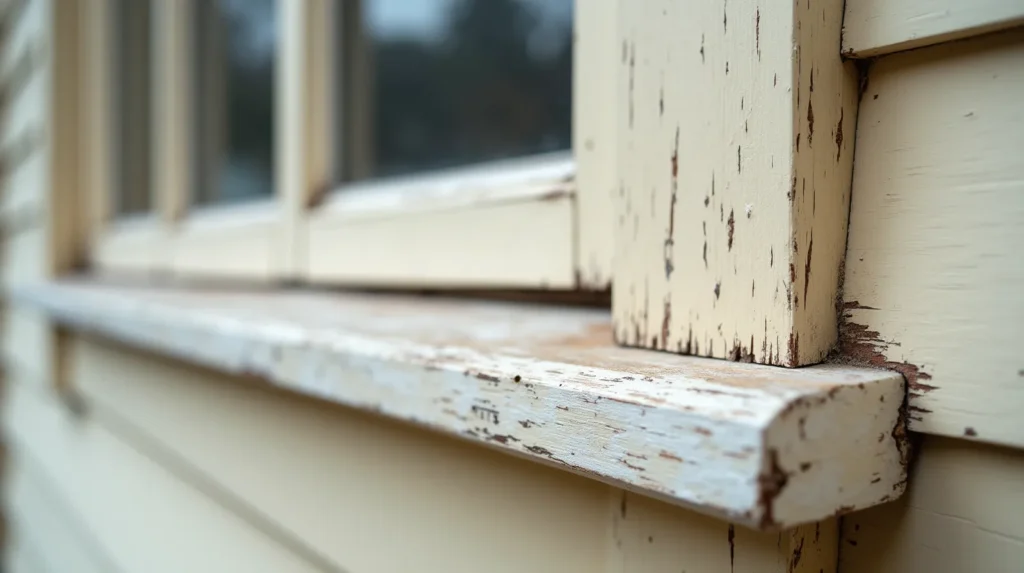
HUD’s minimum property standards (HUD 4000.1 §II.A.3.d) require FHA appraisers to flag any deteriorating paint in a pre-1978 home. Deteriorating means visibly peeling, chipping, chalking, cracking, or damaged paint on any surface — interior or exterior. The appraiser flags it as a safety condition. The lender conditions the loan on remediation before closing. If you won’t remediate, the FHA buyer cannot close.
The VA applies the same standard under VA Pamphlet 26-7, Chapter 12. Most conventional loans backed by Fannie Mae follow similar guidelines in their appraisal requirements. The practical result: a house with deteriorating paint on exterior siding, window sills, porch trim, or interior surfaces cannot close with most financed buyers.
Intact lead paint — fully adhered, undisturbed, not peeling — does not trigger FHA’s remediation requirement. It must be disclosed. It does not need to be removed or covered to complete the sale.
That distinction matters a great deal. A 1955 bungalow in East Nashville with intact original paint and a buyer waiving the lead inspection window can close without any remediation. The same house with peeling paint on window sills cannot close with an FHA buyer until those sills are painted or encapsulated.
What remediation costs — and whether it’s worth doing
When deteriorating lead paint exists, two options are available: encapsulation or abatement.
Encapsulation means covering the deteriorating surface with an EPA-approved sealant or new paint layer. For exterior paint on a typical single-story house, encapsulation runs $5,000 to $15,000 depending on surface area and contractor. It satisfies FHA’s minimum property standard without removing the lead.
Abatement means complete removal — stripping painted surfaces, repainting, sometimes removing and replacing building components entirely. EPA-certified contractors are required for abatement work (40 CFR Part 745, Subpart L). Full abatement on a house with significant lead paint can run $10,000 to $30,000 or more. After abatement, a certified inspector must issue a clearance report before lenders will accept the property.
| Encapsulation | Abatement | Cash sale as-is | |
|---|---|---|---|
| Cost | $5,000–$15,000 | $10,000–$30,000+ | $0 |
| Time to complete | 2–4 weeks | 4–8 weeks | None |
| Opens FHA/VA buyers? | Yes | Yes | Irrelevant |
| Clearance report required? | No | Yes | No |
Whether remediation makes sense depends on what the house is worth before and after. If the house is otherwise in good condition and the market is active, clean lead clearance often nets more than the remediation cost. If the house has deteriorating paint plus a failing roof plus significant deferred maintenance, paying $15,000 to clear one issue on a property you’re discounting heavily anyway rarely adds up.
Why a cash buyer avoids the appraisal problem entirely
A cash buyer does not use an FHA or VA loan. There is no HUD appraiser walking through the property with a minimum property standards checklist. The buyer does their own assessment, makes an offer based on the condition they see, and closes without a lender’s approval chain sitting in the middle.
That does not mean the deteriorating paint has no cost — the offer reflects the condition. But the path from contract to close is a straight line. No conditional remediation requirement. No waiting on an appraiser to sign off on painted window sills before the lender funds.
We have bought pre-1978 houses with peeling exterior paint, intact interior lead paint disclosed up front, and full-building lead assessments on file. The house does not need to be cleared before we make an offer. Submit the address, and you’ll have a number within 24 hours. If the number works, we pick a closing date — 7 to 14 days, or longer if you need more time — no repair conditions attached and no agent commission coming off the top.
When we’re not the right answer
If the lead paint in your house is intact and your house is otherwise solid, a conventional buyer not using FHA or VA financing can often still close without any remediation. Many buyers waive the 10-day lead inspection window, accept the disclosure, and proceed. An agent experienced with pre-1978 homes — there are plenty of them, because the pre-1978 housing stock is enormous — knows how to present the disclosure and work with conventional buyers who understand older houses.
Selling directly to a cash buyer makes the most sense when the deteriorating paint is real and extensive, when you don’t want to spend $5,000 to $30,000 on remediation before listing, when the house has other problems that will push financed buyers further away, or when your timeline requires closing in weeks rather than months. If you have time, a structurally solid house, and the stomach for encapsulation, talk to a local agent first. The math might favor remediation and a higher net sale price. We’ll tell you that even if it means you don’t call us back.
State-specific disclosure requirements on top of the federal rule
The federal requirement is the baseline. Several states add requirements on top of it.
In Tennessee, TCA § 66-5-202 requires disclosure of known material defects, which includes lead hazards. Tennessee does not require lead testing before a sale, but concealing a known hazard exposes the seller to a damages claim up to three years from the date of discovery. Pre-1978 housing stock is dense in Nashville — the bungalows of Sylvan Park, the craftsman homes of Germantown, the older rental stock of East Nashville and Waverly-Belmont — and lead paint is a standard disclosure item in those transactions.
In Texas, TREC Form OP-H (Texas Property Code § 5.008) includes a question about lead paint. Texas does not require testing, but an inaccurate answer on the disclosure form is a misrepresentation the buyer can raise after closing. Pre-1978 homes in Oak Cliff (Dallas) and Montrose (Houston) carry the same disclosure obligations; cash buyers operating in those markets factor lead paint into their as-is offers routinely.
In Florida, § 689.261 covers material defect disclosure, and the federal lead paint rule applies alongside it. Florida has no separate lead paint statute beyond the federal floor. Ybor City in Tampa, the older neighborhoods in St. Petersburg and Fort Lauderdale, and much of the pre-1978 coastal stock carry these obligations. Florida’s insurance market difficulties for older homes do not worsen specifically because of lead paint — the roof age and Citizens underwriting issues affect those same properties more directly.
Massachusetts has the strictest state rule: M.G.L. Chapter 111, Section 197A requires abatement or interim control in any home where a child under six resides, even during a sale. If you’re selling outside Tennessee, Texas, or Florida, check your state’s specific requirements before assuming the federal rule is all that applies.
Straight answers
Do I have to disclose lead paint in a cash sale?
Yes. The federal requirement applies to all residential sales of pre-1978 homes, regardless of how the buyer pays. The exemption list is narrow: commercial property, housing sold after all lead paint has been fully removed and certified clear, and a few other narrow categories. A standard cash home sale does not qualify for any exemption.
Can I sell as-is with lead paint?
Yes. Selling as-is means you are not making repairs as a condition of the sale. It does not mean you skip the federal disclosure. You disclose what you know, give the buyer the EPA pamphlet, offer the inspection window or get a signed waiver, and sell in the current condition. A cash buyer typically waives the inspection contingency and proceeds based on their own assessment.
What if I don’t know whether there’s lead paint?
The disclosure form has a box for that: “Seller has no knowledge of lead-based paint and/or lead-based paint hazards in the housing.” You are not required to test for lead before selling. You are required to disclose what you know. If you genuinely don’t know, say so — and still provide the pamphlet and the inspection window.
Does disclosing lead paint kill a conventional sale?
Not automatically. A buyer using conventional financing — not FHA or VA — is not subject to HUD’s minimum property standard inspection. If the buyer accepts the disclosure, decides they’re comfortable with intact lead paint, and waives the lead inspection period, the sale can close. The risk is that buyers with young children often won’t proceed, and some conventional lenders flag severe visible deterioration in their own appraisal guidelines. Intact paint disclosed to an informed conventional buyer closes more often than it doesn’t.
Will a cash buyer require a lead clearance report before closing?
We do not condition our purchase on a lead clearance report. The offer reflects the as-is condition, including visible deteriorating paint, and we close without a remediation requirement attached. We’ve bought houses with other environmental hazards — asbestos, mold, water damage — and lead paint is handled the same way: the offer reflects reality, and the close happens on schedule.