


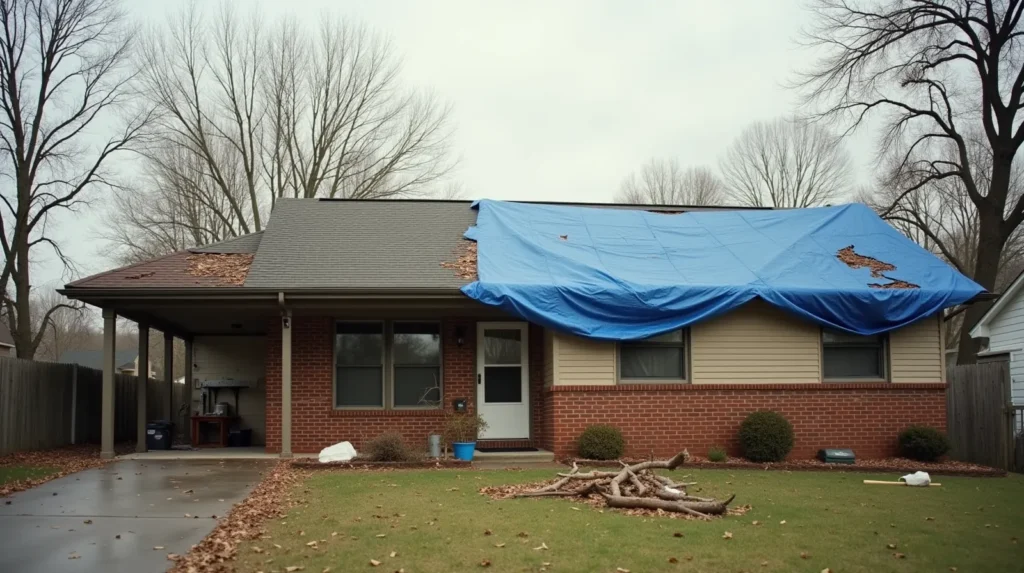
You can sell a house with storm damage. The insurance claim is the part that needs attention.
The house has wind damage, missing shingles, interior water intrusion, or worse. You may have a claim open, or you haven’t filed yet and aren’t sure you should. You want to sell. Here is what you are actually dealing with.
You can sell a storm-damaged house as-is — including with an open insurance claim. At closing, the claim either transfers to the buyer or you settle it and take the check before you leave. FHA and VA buyers are blocked once an appraiser flags the damage. Cash buyers aren’t. An offer within 24 hours, close in 7–14 days.
What storm damage actually does to a conventional sale
Storm damage doesn’t kill a sale. Financing kills the sale.
When an FHA or VA appraiser walks through a property, they check minimum property standards. HUD 4000.1 §II.A.3.b requires a roof to have at least two years of estimated remaining useful life. Missing shingles, exposed decking, or a compromised ridge line triggers a required-repair condition — the lender won’t fund until the seller fixes the damage and a second appraiser signs off. Broken windows, damaged siding, and structural issues fall under §II.A.3.a health and safety standards and get the same treatment.
Conventional appraisers apply similar conditions. A lender doesn’t want to fund a loan on a property with material damage that hasn’t been disclosed, repaired, or priced in.
Cash buyers skip appraisal entirely. They assess the damage themselves, factor the repair cost into the offer, and close. There is no appraiser between the seller and the closing date.
What happens to the open insurance claim
This is where sellers get confused, and where bad advice is common.
If you filed a claim before you sell, the claim doesn’t expire because you transferred title. You have two practical options:
Option 1: Settle the claim first, take the check, then sell. The insurance company pays you for the documented damage. You sell the house in its current condition, disclose the damage, and the buyer knows what they’re buying. The claim money stays with you. This works if the claim is moving and you have time to wait for settlement.
Option 2: Assign the claim to the buyer at closing. In most states, an open property insurance claim can transfer to the new owner. The buyer takes the house and the claim. When the carrier settles, they pay the new owner. This is standard in investor and cash buyer transactions. Your insurance agent can confirm whether your specific policy allows assignment and what documentation the carrier requires.
What isn’t an option anywhere: selling without disclosing the damage.
Texas’s TREC Form OP-H, Section 1, asks sellers directly whether the property has ever been damaged by fire, flood, wind, or hail. Tennessee’s TCA § 66-5-202 requires disclosure of any material defect the seller knows about that would affect the value or desirability of the property. Florida’s § 689.261 covers all known material defects. Prior storm damage — repaired or not — falls under all three.
The repair-vs-sell math
Before you decide, you need a real number from each path.
| Damage level | Repair and list | Sell as-is for cash |
|---|---|---|
| Minor (broken window, partial gutter, 5–10 shingles) | $2,000–$5,000 repair cost + 5–6% agent commission + 30–45 day timeline | Offer within 24 hrs; close in 7–14 days; no commission |
| Moderate (half the roof, several rooms of water intrusion) | $12,000–$30,000 repair + agent + timeline; financing falls through at inspection risk | Offer accounts for repair cost; close date certain |
| Severe (structural, full roof loss, foundation exposure) | $50,000+ repair; most financed buyers exit at inspection or appraisal | Cash buyer is the realistic path; offer based on structure and lot value |
For minor damage with a straightforward insurance claim and 60 or more days, the repair-and-list path nets more. For moderate to severe damage, the financing risk makes the repair path unreliable — buyers who agree at offer stage walk at inspection or appraisal.
Florida: FEMA Substantial Damage, named-storm deductibles, and the insurance crisis
Florida’s insurance market makes storm-damaged properties harder to move through conventional channels than almost anywhere else in the country.
The FEMA Substantial Damage rule. If a property in a Special Flood Hazard Area sustains damage worth 50% or more of the structure’s pre-damage value, FEMA’s 44 CFR Part 60 requires the owner to bring the structure into compliance with current Base Flood Elevation standards before reoccupying. In practice, that means elevating the structure — a cost of $50,000 to $150,000 or more. After Hurricanes Ian and Helene, county building departments in Lee, Charlotte, Collier, and Sarasota counties issued substantial damage determinations to hundreds of properties that appeared repairable. When a determination lands, the conventional repair-and-list math collapses. Cash buyers buy the property at the post-determination value and factor elevation costs into the offer.
Named-storm deductibles. Florida homeowners’ policies contain a separate named-storm deductible calculated as a percentage of the insured dwelling value, not a flat dollar amount. Most FL policies set this at 2% to 5% of insured value. On a home insured at $350,000, that is $7,000 to $17,500 out of pocket before the carrier pays anything. Many sellers discover this only when the claim is filed, after the repair-and-list decision was already made.
The AOB restriction (FL HB 837, 2023). Before July 1, 2023, Florida property owners could sign over claim rights to a contractor through an assignment of benefits. HB 837 (FL § 627.70152) eliminated post-loss AOB for homeowners’ claims. Contractors can no longer file and manage claims on your behalf. For sellers who want to close quickly, assigning the open claim to the buyer at closing is still available — the restriction applies to contractor assignments, not buyer transfers at closing.
Citizens Property Insurance Corporation restricts new policies on homes with roofs older than 25 years. If your roof sustained hurricane damage and a buyer can’t get a new Citizens policy to bind, they can’t get a mortgage — even if your existing policy is currently active on the property. Following Hurricanes Helene and Milton in 2024, private insurers across Tampa Bay, Sarasota, Southwest Florida, and South Florida have been non-renewing policies and declining new coverage in wind-exposed areas. Cash buyers carry no lender and no insurance requirement.
NFIP (National Flood Insurance Program) claims transfer to the new owner the same way a standard property claim does. If the property carries an elevation certificate, share it — it affects flood insurance costs for any buyer who needs a policy.
For more on the Florida selling process, see our Florida page.
Texas: hail capital and the TREC disclosure
The Dallas–Fort Worth Metroplex is one of the most hail-impacted real estate markets in the country. In an above-average year, storms large enough to total a residential roof hit multiple neighborhoods across Collin, Denton, Dallas, and Tarrant counties in the same season.
The practical problem for sellers: documented hail damage or a prior hail claim often triggers a condition during a buyer’s insurance underwriting — not just the appraisal. The carrier will restrict the policy, require a roof replacement certificate, or decline to bind. When insurance falls through, the mortgage falls through.
Texas’s TREC Form OP-H, Section 4, includes specific questions about whether the property has ever been “damaged by fire, flood, wind, or hail.” Section 1 asks about previous flooding. An answer of no when there is documented storm damage creates a disclosure liability that survives closing. Cash buyers skip the insurance underwriting step entirely.
Tennessee: tornadoes and the disclosure obligation
Middle Tennessee is in a persistent tornado corridor. On the night of March 3, 2020, tornadoes struck Davidson County and Putnam County within hours of each other — destroying blocks in East Nashville and Germantown, and leveling parts of Cookeville. The combined toll was 25 deaths and more than 1,000 damaged structures. Subsequent storm seasons have brought significant events to Williamson, Sumner, and Rutherford County suburbs.
Tornado damage at that scale — roof trusses compromised, framing exposed, interior water intrusion — is exactly the condition that kills financed deals. An appraiser who sees structural damage covered by tarps or partial repairs that don’t meet code will issue a required-repair condition. Repair estimates for major structural damage run $30,000 to $80,000 or more.
Tennessee sellers must disclose known material defects under TCA § 66-5-202. Tornado damage that has been fully repaired with permits pulled and inspections passed is history, not a current defect. Damage that has been patched but not properly repaired is a material defect and must be disclosed. For sellers in Davidson, Williamson, Rutherford, Sumner, or Putnam County with homes that took storm damage and have partial repairs or unresolved structural issues, a cash offer is based on what the house is — not what it was before the storm.
When not to sell to us
A cash offer on a storm-damaged house makes the most sense when the damage is extensive, when the insurance timeline is stalled, or when a conventional buyer pool is practically unavailable.
It doesn’t make sense in every situation.
If the damage is minor — a handful of shingles, cracked siding on one elevation, a single broken window — and you have an active, progressing claim, the repair cost after settlement is likely $3,000 to $8,000. Once the insurance company pays, you repair, disclose the prior damage, and list. In a moving market with 60 days or more to work with, an agent will net you more than a cash offer. The 5–6% commission will generally be less than the discount a cash buyer applies for uncertainty and repair risk.
Ask us for a number and compare it to a repair estimate. If the conventional path makes more sense, the math will show it.
How to get a cash offer
Submit the address in the form above. We review the property — in person or by photos, depending on location. A cash offer comes back within 24 hours. No obligation to accept it.
We buy directly, and where we’re not the right buyer we’ll connect you with a cash buyer from our network who is. Either way: no commission, no repairs, no showings, no financing contingencies.
We handle all condition levels. We’ve worked on properties with active water damage, fire damage, and roof failure. Storm damage is a condition we know. Call us at (615) 780-7349 or use the form above to get started.
Keep reading
- Best Home Offer Today Reviews: In Sellers’ Own Words
- Sell My House Fast San Antonio TX
- We Buy Houses in Florida
- Sell My House Fast Virginia Beach VA
- Sell My House Fast Broken Arrow OK
- Sell Your House Without a Realtor: Your Two Real Options
Ready for a number? Get your cash offer or call (615) 780-7349.