


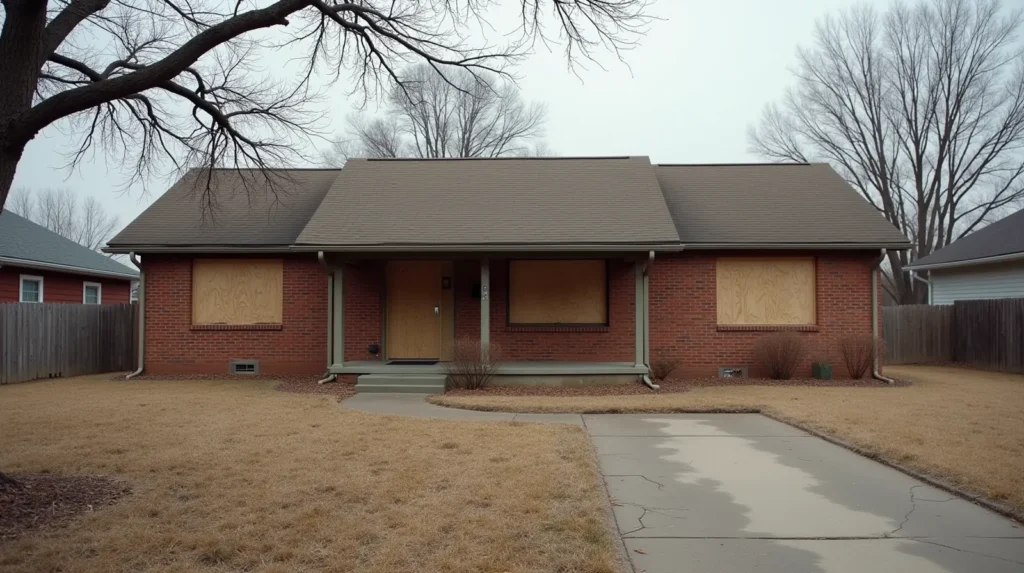
Yes. But the buyer pool just got very small.
The placard went up last month. A Memphis codes inspector walked through and marked your family’s house unfit for habitation. Or a Nashville Metro Codes notice arrived in the mail with a compliance deadline. Either way, you’re wondering if you’re stuck.
You’re not. A condemned house can be sold. What changes is who will buy it.
Short answer: Yes, you can sell a condemned house — in Tennessee or anywhere else. The catch: only a cash buyer will touch it. No mortgage lender will approve a loan on a condemned property. Outstanding municipal liens get paid from the sale proceeds at closing, and you walk away with what’s left. Selling as-is is exactly the path for this situation.
What “condemned” actually means here
The word gets used two different ways, and the distinction matters.
Building code condemnation is what most homeowners face. A local authority — Metro Codes in Nashville, Shelby County in Memphis, Knoxville’s Department of Development Services — inspects the property and determines it’s unfit for habitation. A placard goes on the door. In Tennessee, the governing framework is T.C.A. § 13-21-101 through § 13-21-116 (Unsafe and Substandard Structures). The property is not seized. You still own it.
Eminent domain is different. The government wants the land for a road, a school, a flood-control project. They pay you and take it. That process is governed by T.C.A. § 29-17-101 et seq. and is entirely separate from what this page covers.
For most homeowners reading this, it’s the first kind: a placard, outstanding violation notices, and a deadline before the city moves to demolish.
Can you still sell a condemned house in Tennessee?
Yes — right up until the moment a government-ordered demolition physically begins.
Legal title stays with you as long as you own the property. Tennessee has no statute that bars the sale of a condemned structure. Under T.C.A. § 66-5-202, you are required to disclose the condemnation status and any known material defects to the buyer. That disclosure does not block the sale. It just has to happen.
What blocks most sales is financing. No FHA-approved lender, VA lender, or conventional bank will underwrite a mortgage on a condemned structure. HUD Handbook 4000.1 and VA Lender Handbook Chapter 12 both treat uninhabitable or condemned properties as ineligible for loan guarantees. The buyer pool narrows to two categories: cash investors who plan to rehabilitate, and cash buyers — like us — who buy as-is.
What happens to the outstanding liens
This is the piece that scares most people, and it is more manageable than it looks.
When a Tennessee municipality issues a condemnation notice, it often records a lien against the property for inspection costs, administrative fees, or outstanding code violation penalties. In Nashville, Metro Codes does this under T.C.A. § 13-21-109. In Memphis, Shelby County Codes records similar administrative liens. These are not hidden. A title search turns them up before closing.
At closing, those liens get paid from the sale proceeds before you see a dollar. The title company settles them. The buyer does not inherit the liens — that is a common misunderstanding. The closing process extinguishes them.
The number that matters: whether the equity left after liens is positive. If the property has no equity — liens exceed value — that is the conversation to have before going further. If there is equity, the process is straightforward. This situation is similar to selling a house with a lien, where liens clear at the closing table regardless of type.
Three steps from condemnation notice to closing
Here is what the process looks like when you work with us:
1. Give us the address. We pull the outstanding violation notices from county records before making an offer. In Davidson County, that is the Metro Codes database (nashville.gov). In Shelby County, it is ePlans Online. In Knox County, it is Knoxville’s Building Inspections portal. Most municipalities make this public.
2. We give you a cash offer within 24 hours. The offer accounts for the liens, the land value, and the estimated cost to rehab or demolish. It will not be market rate for a move-in-ready house — condemned properties sell at a discount because the buyer absorbs all rehabilitation risk. We are straightforward about the number and what goes into it. No fees, no commissions.
3. You pick the closing date — typically 7 to 14 days. The title company clears the liens. You keep what remains after liens are satisfied. No agent commission (that is 5–6% you keep), no cleaning, no repairs, no showings.
The demolition timeline you actually need to know
Tennessee municipalities can move to demolish a condemned structure and bill the owner for it.
In Nashville, Metro Codes can petition a judge for a demolition order under T.C.A. § 13-21-107 when a condemned property sits past the compliance deadline. Davidson County has followed through in East Nashville, Bordeaux, and North Nashville on structures where the owner did not respond. Demolition of a single-family house in the Nashville metro typically runs $8,000 to $25,000 depending on size and materials — and that cost becomes a lien added on top of existing violations.
Shelby County (Memphis) runs its own demolition authority with an active backlog in Orange Mound, Frayser, and Binghampton. Knox County pursues condemned structures through its Environmental Court.
Once demolition costs get stacked onto existing liens, the remaining equity shrinks or disappears. Selling before demolition is almost always the better outcome — this is the same urgency logic that applies when selling before a foreclosure date: the clock is real, and it runs in one direction.
When you should not sell to us
Honestly: if the structure is worth repairing, repair it first.
A house condemned for a single plumbing failure or a roof deficiency that has already been corrected has a path back to full market value with a licensed contractor. If the violations are curable for $15,000–$35,000 and you have the time and cash, repairing and listing with an agent will almost always net more than a cash offer.
We are the right option when:
- Structural, mechanical, or foundation repairs exceed $60,000
- A demolition order deadline is approaching
- The estate is in probate and the executor cannot manage a rehabilitation project
- There is no equity left after repairs — selling as-is still puts something in your pocket
- The property has been vacant long enough that the code violations compounded
To be direct about how we work: we buy houses directly with our own money, and for some properties we bring in a network of other cash buyers and real estate companies. In both cases, the offer comes within 24 hours and no fees come out of your side of the transaction.
Condemned house in Tennessee: what the law actually says
The statute framework for sellers:
- T.C.A. § 13-21-101–116 — Unsafe and Substandard Structures Act: gives municipalities authority to condemn, post notice, order repairs, and pursue demolition
- T.C.A. § 13-21-109 — Administrative liens: allows municipalities to record the cost of inspections, enforcement, and demolition against the property
- T.C.A. § 13-21-107 — Demolition authority: the court process by which a municipality gets an order to demolish at owner’s expense
- T.C.A. § 66-5-202 — Residential Property Disclosure: you must disclose the condemnation status and known defects to any buyer. The TREC Residential Property Disclosure Form has a dedicated section for this.
The disclosure requirement is non-negotiable, but it does not prevent the sale. Cash buyers buying as-is sign off with full knowledge of condition.
Straight answers
Is a condemned house worth anything?
Yes — primarily land value, plus whatever rehab value the structure still holds. In Nashville, lots in Bordeaux and North Nashville carry real value even when the structure needs demolition. In Memphis, an East Memphis lot is worth more than one in Frayser. The number depends entirely on location, lot size, and zoning.
Do I pay the city before I can sell?
No — outstanding administrative liens get resolved from sale proceeds at closing. You do not pay out of pocket unless there is no equity left to cover them.
What if there is a demolition order already issued?
You can still sell up until the moment demolition physically begins. Call us. We have closed on properties with active demolition orders. Time is the binding constraint, not the order itself.
What is the difference between condemned and uninhabitable?
Uninhabitable means the property fails habitability standards but has not been formally condemned by a government authority. Condemned means the authority has posted official notice and ordered the property vacated. Both eliminate conventional financing. Both are properties we buy.
Can I sell a condemned house in Florida or Texas?
Yes, the same principle applies. Florida’s condemnation authority flows through local code enforcement under F.S. § 162.06. Texas municipalities use Chapter 54 of the Local Government Code. No mortgage lender touches a condemned structure in any state. Cash is the only path.
Can a condemned house be repaired and sold to a regular buyer?
Yes, if the municipality lifts the condemnation after repairs pass re-inspection. Once the property is reinspected and the notice is removed, conventional financing becomes available again. The question is whether the repair cost is worth it relative to a cash sale now. If you have 60+ days and $20,000–$40,000 in repair budget, that is the calculation to run with a contractor before calling us.
One number to know
The compliance date on that notice. Not a general sense of urgency — the specific date printed on the condemnation order. That is what drives the demolition timeline and the equity math.
Give us the address. We will pull the violation history from the county records and have a cash offer to you within 24 hours. Call (615) 780-7349 or read how code violations affect as-is sales if you want more background first.
Keep reading
- Can You Sell a House With Plumbing Problems?
- Can I Sell a House with Galvanized Pipes?
- Sell My House Fast Converse TX
- Can I Sell My House to Stop Foreclosure?
- Sell My House Fast Madison, AL
- Selling a House With Water Damage: What Actually Happens
Ready for a number? Get your cash offer or call (615) 780-7349.