


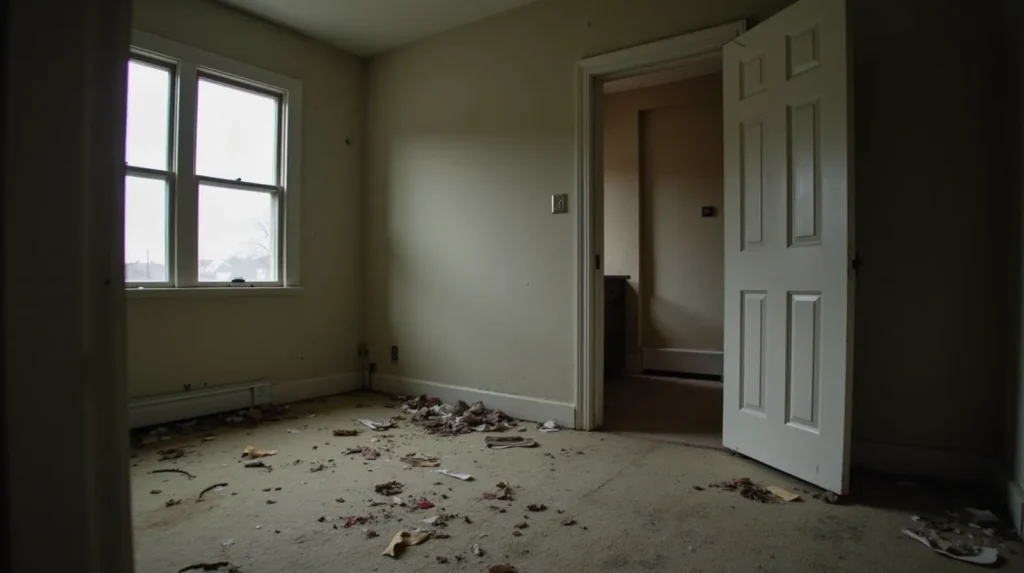
Yes — and you can close in 7 to 14 days, not wait on contractors
Tenants left. The house looks like it took a hit. Carpet shredded, walls punched, appliances gone, pet damage soaked into the subfloor. The security deposit is gone and the repair estimate is sitting on the counter at $22,000.
You can sell the property exactly like this. A cash offer arrives within 24 hours of giving us the address. No repairs required before closing.
- Sell as-is — no repairs, no cleaning, no contractor schedule to wait on
- Cash offer within 24 hours of submitting the address
- Close in 7 to 14 days, on the date you pick
- No agent commission — that is 5 to 6% you keep
- Tenant damage does not delay or complicate the closing
Why tenant damage kills conventional financing — and what that means for your sale
The damage does not just affect the property. It affects who can buy it.
FHA loans require the property to meet HUD’s Minimum Property Standards before the loan closes. Significant damage — holes in walls, missing fixtures, destroyed flooring, non-functioning HVAC or plumbing — creates appraiser-required repairs the seller must complete before the lender will fund. VA loans carry even stricter Minimum Property Requirements. Both programs screen for “safe, sound, and sanitary,” which a badly trashed rental often cannot pass.
Conventional loans (Fannie Mae, Freddie Mac) are more flexible, but an appraiser still notes material defects. A buyer using conventional financing may require repair concessions or a reduced price that triggers their own lender’s conditions.
The practical result: a damaged rental property on the open market attracts a smaller buyer pool — investors and cash buyers only. You’re selling into that pool either way. The question is whether you do it through a 90-day listing process, or in 7 to 14 days.
The repair-or-sell math that most landlords work out too late
A landlord who walks into a trashed property typically faces three choices:
- Repair fully, then list with an agent. Typically 60 to 90 days to close from the day contractors finish. Repair cost comes out of pocket. Agent commission runs 5 to 6%. The house may sell for more, but the gap between gross sale price and net-in-pocket is large.
- List damaged, at a discount. The discount a retail buyer demands for an as-is damaged property is often larger than what a cash buyer would take, because the retail buyer also prices in financing risk, holding cost, and contractor uncertainty.
- Sell as-is to a cash buyer. Fastest path to net proceeds. No repair cost. No contractor timeline. No agent commission. The offer will be below what a fully repaired property would fetch — that is the trade, and it is a knowable, upfront number, not a guess.
The math turns on repair cost. If repairs run $4,000 and you have 60 days, doing the work and listing with an agent often nets more. If repairs run $20,000-plus and you need the money in the next two weeks, the cash route is usually the faster path to a real number.
We have bought more than 100 houses this way. If you want to see what the as-is process looks like in practice, this page covers it in detail.
Tennessee’s security deposit rules — and why the deposit rarely covers it
In Tennessee, the Residential Landlord and Tenant Act (Tennessee Code Annotated Title 66, Chapter 28) caps residential security deposits at two months’ rent for unfurnished properties. On a $1,300/month rental, that is $2,600 maximum.
Significant tenant damage — flooring replacement, wall repair, appliance replacement, remediation for pet waste — routinely runs $10,000 to $30,000 or more. The deposit covers a fraction of that.
Under TCA § 66-28-301, the landlord must return the security deposit, with an itemized written statement of any deductions, within thirty days of termination of the tenancy. Document everything with photographs dated at move-out. The statement needs to be specific: “carpet replacement, bedroom 2, $840” not just “damages.” Without documentation, the landlord may forfeit the right to make deductions at all.
Taking the tenant to civil court — what it is actually worth
For damage that exceeds the security deposit, Tennessee landlords can file in General Sessions Court. In Davidson County, that court is at 1 Public Square, Suite 302, Nashville. General Sessions handles claims up to $25,000 without an attorney requirement. Circuit Court handles larger claims but involves more time and legal cost.
The honest answer on pursuing a former tenant: you may win the judgment and collect nothing. Many tenants who badly damage a property have no meaningful assets to attach. A judgment sits on their credit record but it does not put money in your account unless there is something to collect — wages to garnish, a bank account to levy. An attorney can tell you, after a 30-minute conversation and a look at what you know about the tenant, whether collection is likely.
Selling the property does not give up your right to sue the former tenant for the damage. Those are separate claims. The cash sale closes the chapter on the property. The civil case, if you pursue it, runs separately.
When to repair first, not sell as-is
A cash sale trades speed and certainty for some of the sale price. That is the right trade in some situations and the wrong one in others.
If the damage is cosmetic — deep cleaning, carpet replacement, minor drywall work — and you can spend $3,000 to $5,000 and turn the house over in two weeks, a retail listing will almost certainly net you more. The spread between a cash offer on a cosmetically damaged house and a retail sale price after light repair is often large enough to justify the repair.
If you have a homeowner’s insurance policy that covers tenant-caused damage (some landlord policies include it, most standard homeowner policies do not), file the claim before you decide. The insurance payout can change the math substantially.
If the property has significant equity and time is not urgent, getting three repair bids before deciding is worth the two days it takes. The cash offer will still be there; you are not choosing between options that expire at different times.
If you are also dealing with back rent, a property lien, or a foreclosure clock, those layers can change the urgency calculation — this page covers the foreclosure timeline specifically, and this one covers liens at closing.
What happens after you give us the address
- We assess the property and send a written cash offer within 24 hours.
- You accept, or you do not — no obligation at any point.
- You pick a closing date. Typically 7 to 14 days, or longer if you need more time.
- The title company does a title search and handles any liens from the proceeds at closing.
- On closing day, the title company sends the balance to you by wire.
- You walk out of the closing table with the property gone and the check in hand — no contractors, no showings, no waiting.
We buy houses directly and, where we are not the right buyer, we connect sellers to our network of cash buyers — including licensed real estate companies. Either way, the offer, the timeline, and the as-is terms are the same.
We have also worked with landlords selling properties that still have tenants in them — the mechanics differ from a vacant damaged property, but the as-is principle is the same.
Ready to see the number?
Submit the address below. An offer comes back within 24 hours. No repairs, no commissions, no obligation to accept.
Call us at (615) 780-7349 if you want to talk through the situation first.