


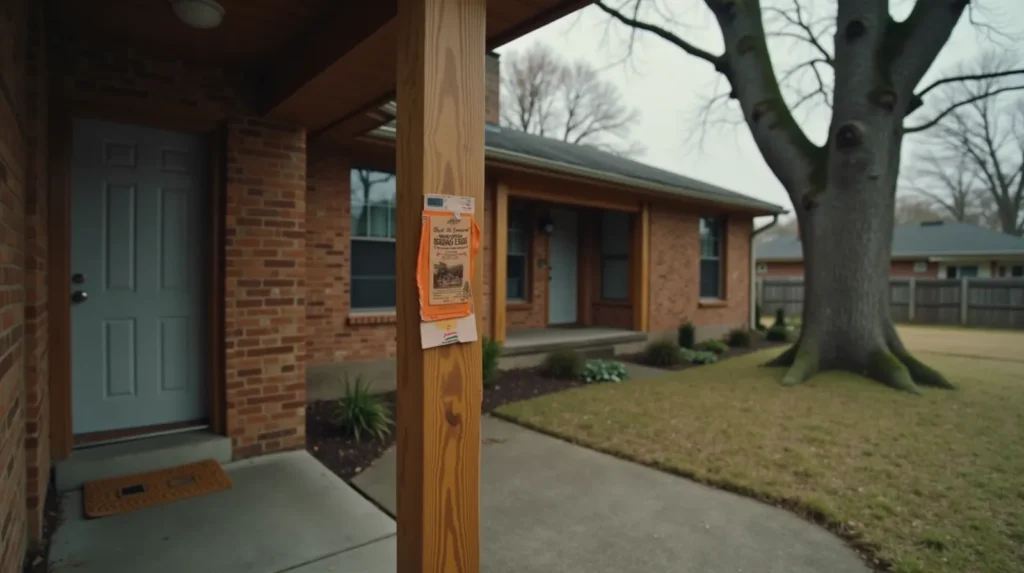
What an open permit actually means at closing
Your house has an open permit. Maybe you found it yourself. Maybe a title search surfaced it and your buyer’s lender is now stalling. Either way, the problem is not the permit itself — it is what happens when a title company searches the county building department records and finds a permit still listed as active, issued, or pending instead of finaled.
Here is what happens: most mortgage lenders require title insurance before they fund a loan. Title underwriters — Fidelity National Title, First American, Chicago Title, Old Republic — routinely pull permit histories before issuing a policy. An open permit shows up as an unresolved item. Many title underwriters will refuse to insure, require the permit closed before closing, or demand the seller escrow funds. Without title insurance, the lender does not fund. Without funding, the financed buyer cannot close.
A cash buyer has no lender. No lender means no title insurance requirement. We can evaluate the open permit as part of the property condition, price for it, and close anyway.
TL;DR: Yes, you can sell with open permits — but financed buyers hit a title insurance wall that kills most closings. A cash buyer has no lender and no title insurance requirement. If the permit is for simple work and closeable in under a month for under $500, close it first and list with an agent. If not, a cash offer is the faster path.
The difference between an open permit and unpermitted work
These two problems get conflated constantly. They are not the same thing.
Unpermitted work means the work was done without pulling a permit at all. It surfaces when an appraiser notices a room addition, converted garage, or finished basement with no permit record attached. That is an appraisal problem and a disclosure problem — the work may not meet code, and the appraiser flags it as a lender repair condition. We cover that situation on our page about selling a house with unpermitted work.
An open permit means the work was done with a permit — correctly and legally started — but the final inspection never happened. The contractor pulled the permit, did the work, and never called for the inspector to come back and sign off. The county still shows the permit as open.
The open permit is a title issue, not an appraisal issue. It only surfaces at the title search stage. The work itself may be perfectly sound. The problem is a paperwork gap in the county record.
Why financed buyers are blocked
The standard closing process for a financed sale includes a title search at the county recorder and a permit search at the local building department. When the permit search returns an open item, the title underwriter sees potential risk: work that was started under permit was technically never verified as complete per local code standards.
Title underwriters have three paths when they find an open permit:
- Require the permit to be closed before closing — the most common response
- Accept a cash escrow holdback — typically 150% of the estimated close-out cost — held until the permit is resolved after close
- Decline to insure on properties with multiple old open permits or permits tied to structural work
When the underwriter requires closure and the permit cannot be resolved in time, the deal stalls or falls apart. When they decline entirely, the financed buyer has no path forward.
How to close an open permit — and what it actually costs
The process depends on how old the permit is and what work it covers.
Recent permit, simple work (water heater replacement, HVAC unit, deck, window replacement): Call the contractor who pulled the permit. In most cases they can schedule a final inspection within one to two weeks. Building department inspection fee: $50–$150. Contractor trip charge: $150–$300. Total: under $500. Timeline: two to four weeks.
Older permit, original contractor gone: If the contractor is out of business, you need a new licensed contractor to review the work, certify it meets current code, and request the final inspection. If current code requirements have changed since the work was done — which is common for electrical or HVAC permits more than ten years old — corrections may be required before the inspector signs off. Timeline: four to twelve weeks. Cost: $500–$5,000 depending on the scope of corrections.
Very old permit, complex or structural work: Some jurisdictions offer administrative closure for permits that have sat open for fifteen to twenty years with no complaints. Others require full re-inspection and as-built documentation. If original drawings no longer exist and the scope cannot be verified, an engineering review may be required before the county will close the permit — adding months to the process.
| Scenario | Timeline | Estimated Cost |
|---|---|---|
| Simple work, contractor available | 2–4 weeks | Under $500 |
| Older permit, new contractor needed | 4–12 weeks | $500–$5,000 |
| Structural work with code corrections | 2–6 months | $2,000–$20,000+ |
| Administrative closure (old minor work) | 4–8 weeks (varies by county) | $150–$500 filing fee |
Tennessee: Metro Nashville and the surrounding counties
Metro Nashville Codes Administration maintains a public permit lookup at codes.nashville.gov. Title companies searching Davidson County properties access it routinely, and permits that have sat open for ten or fifteen years surface on the search the same as new ones.
Williamson, Rutherford, Sumner, and Wilson counties each maintain their own separate building department records. A property that has had work done under different eras of ownership may have permits in multiple county systems — each requiring its own search.
Tennessee disclosure law under TCA § 66-5-202 requires sellers to disclose known material defects. An open permit indicating work that was never inspected and finaled is a material defect you are required to disclose once you know about it. The same statute applies to code violations more broadly.
If you are also behind on payments, Tennessee’s non-judicial foreclosure process under TCA § 35-5-101 can move to a trustee’s sale in 60 to 90 days. An open permit that stalls the title search adds delay you cannot afford on that timeline. We cover the timing in detail on the page about selling a house to stop foreclosure.
Florida: permit enforcement tightened after Surfside
Florida’s permit compliance environment changed after the June 2021 Surfside condominium collapse. Miami-Dade and Broward counties increased enforcement and expanded permit history requirements as part of the broader response to inadequate structural oversight. The practical effect: permit searches at Florida closings are now more thorough, and older open permits that sat unremarked for years surface more often than they did before 2021.
Florida Statute § 689.261 requires sellers to disclose code compliance history. A known open permit is a required disclosure item.
Florida’s larger counties each run separate permit portals. Hillsborough County uses MyPermitNow. Pinellas County uses CCAPPRD. Lee and Collier Counties use their own systems. Each must be searched independently — and title companies handling Florida closings do exactly that.
Condo sellers face an additional layer: in some Florida developments, the condo association’s estoppel letter package includes a permit history review. Open permits that would not complicate a single-family sale may appear as transfer conditions in HOA documentation. We work with Florida sellers across these situations regularly.
Texas: permits by city, and the unincorporated county difference
Texas has no statewide permit database. Each municipality operates its own system. Austin uses Development Services. Dallas uses Building Inspection. San Antonio uses Development Services. Houston uses PermitsPlus. A permit pulled with the City of Houston shows up in Houston’s records, not Harris County’s. Title companies search each city’s system independently.
TREC Form OP-H — Texas’s standard seller disclosure — Section 4 asks directly about alterations and permits. A seller who knows about an open permit and omits it from this form is in violation of Texas Property Code § 5.008.
One distinction that matters in Texas: unincorporated county areas in Kaufman, Parker, and Johnson counties sometimes had no permit requirement at all for work done more than fifteen years ago. When a title search returns no permit records for a property in one of these areas, it is not necessarily a problem. Cash buyers purchasing in unincorporated Texas are well-suited to these properties precisely because the title picture is simpler.
When you should not sell to us
If your open permit is for a water heater replacement, an HVAC unit, a furnace, or a simple deck — call the contractor who did the work. In most cases they can get the final inspection scheduled within two weeks for under $500. Close the permit, then list with an agent. You will net significantly more money.
If the permit is recent and the original contractor is still operating, permit closure is almost certainly the right path first.
The situations where a cash sale makes more sense:
- The original contractor is out of business and cannot be located
- The open permit covers structural work that requires significant corrections to meet current code
- Multiple permits from different eras are stacked, each requiring its own resolution process
- You are on a hard deadline — a foreclosure date, a court order, a relocation date — that a 6-to-8-week permit closure process cannot fit
- The permit was pulled for work that was never completed, and the incomplete work is itself the bigger problem
For comparison, here is how the two paths typically look for a seller with a single resolvable open permit:
| Factor | Close permit, then list | Sell as-is to cash buyer |
|---|---|---|
| Timeline | 4–10 weeks to close permit + 45–60 days to close sale | 7–14 days to close |
| Net proceeds | Higher — full market price minus agent fee | Lower offer price, zero commission or fees |
| Risk | Permit closure may reveal code corrections adding cost | No correction risk; offer priced accordingly |
| Best for | Minor permit, contractor available, no deadline | Multiple permits, gone contractor, hard deadline |
Three steps, and you can stop at any one
- Pull your permit history. Search your county or city building department’s online portal. Enter your address. Permits showing as “issued,” “active,” or “pending” — rather than “finaled” or “closed” — are open. Nashville: codes.nashville.gov. Houston: permitsplus.com. Pinellas County: ccapprd.pinellascounty.org.
- Call the contractor who pulled each permit. Ask if they can schedule the final inspection. Get a timeline and a cost estimate. If the permit can be closed in under a month for under $500, do it — then list the house or sell it as-is on the market.
- If step 2 is not viable, give us the address. We will review the permits, evaluate the property, and have a cash offer to you within 24 hours. We have bought more than 100 houses. Open permits show up regularly and we price for them rather than walk away.
Straight answers
Does an open permit prevent me from selling?
No. It prevents most financed buyers from closing, because their lender requires title insurance and most title underwriters will not insure with unresolved open permits. A cash buyer has no lender and no title insurance requirement.
Will a title company always find my open permit?
Yes, if your county or city building department maintains a searchable permit database — which most do. Open permits from 15 or 20 years ago surface just as reliably as recent ones.
Can I sell without disclosing an open permit I know about?
No. TCA § 66-5-202 in Tennessee, Florida § 689.261, and Texas Property Code § 5.008 all require disclosure of known material defects. A known open permit is a required disclosure. Non-disclosure creates civil liability.
What if the open permit is from work done by a previous owner?
The permit attaches to the property address, not the person who pulled it. You carry the resolution responsibility when you sell, regardless of who did the work.
How long does it take to close an open permit?
Simple work with the original contractor: two to four weeks. Permits requiring code corrections: four to twelve weeks. Structural work needing engineering review: two to six months. Very old permits with missing documentation: call your local building department directly — timelines vary by jurisdiction.
Give us the address
Open permits are a title problem, not a deal-killer for every buyer. If you cannot resolve them in time, we can evaluate the property as-is, price for what the permit means in practice, and close in 7 to 14 days. Call us at (615) 780-7349 or submit your address below for a cash offer within 24 hours. No fees, no commission, no obligation.
Keep reading
- Sell My House Fast in St. Charles, MO
- Sell Your House Without a Realtor: Your Two Real Options
- How to Sell a House As-Is: What the Discount Really Is
- Sell My House Fast Decatur, AL
- Selling a House With Electrical Problems
- Best Home Offer Today Reviews: In Sellers’ Own Words
Ready for a number? Get your cash offer or call (615) 780-7349.