


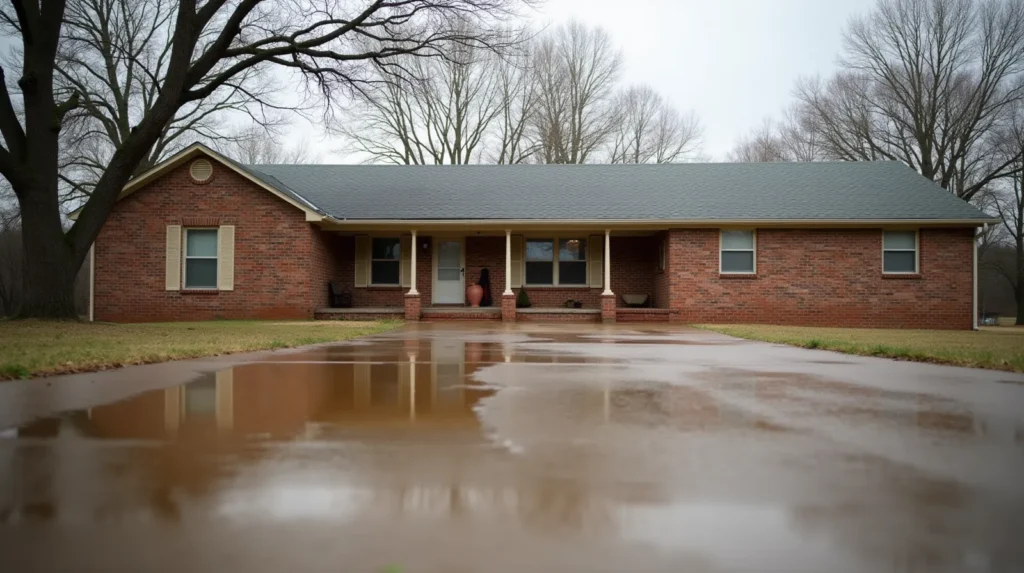
Water got in. Maybe a roof let go, a pipe burst, or flood water came through after a storm. Now you need to sell, and you’re not sure whether to repair first, list and disclose, or take a cash offer and close.
The answer depends on three things: how much damage there is, whether you have insurance coverage, and how much time you have. This page covers all three paths.
The short version: You can sell a house with water damage as-is — no repairs required if you use a cash buyer. Tennessee and Florida both require disclosure of known water damage, repaired or not. Cash offer within 24 hours. Close in 7–14 days. We handle remediation after we buy.
What Tennessee and Florida require you to disclose
Every state we work in applies the same standard: if you knew about it, you must disclose it. This applies even if the damage was repaired.
Tennessee — TCA § 66-5-202 requires the seller to complete a Residential Property Condition Disclosure form and list all known material defects. Tennessee courts have held that failing to disclose prior water damage constitutes fraudulent concealment, even after repair. “It was fixed” is not a defense if the buyer can prove you knew about it before the sale.
Florida — Florida Statute § 689.261 applies the same standard: known material defects must be disclosed. The FARBAR Residential Contract disclosure section includes specific checkboxes for flood damage and prior water intrusion. One additional Florida requirement: if the property sits in a FEMA Special Flood Hazard Area, the seller must disclose that fact separately.
Texas — The Seller’s Disclosure Notice (TREC Form OP-H) asks specifically about flooding, standing water, and water penetration. Texas courts apply the “as-is” clause narrowly — it does not protect a seller against claims of concealing known damage.
The disclosure itself is not the problem. The problem is what happens next: financed buyers often cannot get mortgage approval on a home with active water damage, and homeowner’s insurance for a property with a recent claim history can be hard to obtain. That narrows the buyer pool to cash.
How much does water damage reduce what you can sell for
There is no universal number. It depends on the extent of the damage, whether it has been remediated, and what caused it.
A minor, repaired roof leak documented with contractor receipts might reduce your sale price by 5–10% if properly disclosed and remediated. Active water intrusion — standing water, saturated subfloor, damaged structural members, or visible mold — is a different situation. Lenders typically won’t fund a mortgage on a home with active or unremediated water damage. That makes it a cash-only sale by default.
Professional remediation (water extraction, structural drying, mold testing, reconstruction) typically runs $3,000–$20,000 for moderate residential damage and significantly more for a flooded basement or crawl space.
| Repair then list | Sell as-is to a cash buyer | |
|---|---|---|
| Timeline | 4–8 weeks minimum | 7–14 days |
| Remediation cost | $3,000–$20,000+ out of pocket | $0 — buyer handles it |
| Lender financing available | Yes, after remediation and appraisal | Not required |
| Agent commission | 5–6% of sale price | None |
In most cases of significant damage, net proceeds after remediation cost, agent commission, and holding time are closer to a cash offer than sellers initially expect.
What happens to your insurance claim if you sell
This is the question most pages skip. When a claim is already open, it matters.
If your insurer has already paid the claim, those funds belong to you. Selling the property doesn’t return the money to the insurer. If remediation has already happened and the damage is repaired, those costs are settled and the sale moves forward normally.
If your claim is still open — the adjuster hasn’t finalized the payout — the situation is more complicated. A pending insurance claim does not automatically transfer to a buyer. Most title companies require the claim to be resolved before or at closing. A cash buyer experienced with damaged properties can sometimes work around an open claim, but it must be disclosed and negotiated upfront.
One Florida-specific note: if the property has had one or more water damage claims in the past three to five years, getting new homeowner’s insurance is often difficult. Citizens Insurance (Florida’s insurer of last resort) has specific restrictions around claim history. If a buyer can’t insure the property, a financed purchase isn’t going to happen. That’s not the seller’s problem to solve — but it is the seller’s reality to plan around.
For Tennessee homeowners near Nashville: the Cumberland River tributaries — including Mill Creek through Antioch and Whites Creek north of the city — have flooded repeatedly in past years. Homes in those corridors are familiar to adjusters here, and flood damage history shows up in title searches.
Who buys water-damaged houses
Cash buyers. For actively damaged or heavily impacted homes, that is effectively the only buyer category.
Most iBuyers decline to bid on homes with active damage or recent claims. Traditional buyers using lender financing are locked out by appraisal and insurance requirements.
We’ve bought more than 100 houses, including properties with significant water damage. The process is the same regardless of condition: give us the address, we review it (sometimes with a walkthrough, sometimes from photos and damage documentation you have), and we make a cash offer within 24 hours. You don’t repair, clean, or remediate anything. We buy it the way it is. And where we’re not the right buyer, we’ll connect you with one who is.
If the situation involves mold from water exposure — which it often does — that’s also something a cash buyer can handle. We’ve covered what happens when a house has mold in a separate post.
Three steps after you contact us
Here’s what happens after you give us the address:
Offer within 24 hours. We review the property — size, location, damage description, any inspection or claim documentation you have. The offer reflects the current condition.
You decide. No pressure, no deadline on our side. Take it, turn it down, or get other offers to compare.
Close on your schedule. As soon as seven days, or later if you need more time to move. You pick the date. We cover closing costs. No fees, no commission.
When you should not sell to us
If the water damage is minor — one past leak, documented repairs, no mold, no structural impact — and you have 60 or more days before you need to close, listing with an agent will almost certainly net you more money. The disclosure requirement applies either way, but a remediated and documented home can qualify for financing and attract the full buyer pool.
A cash offer makes more sense when:
- Active water intrusion hasn’t been repaired
- A prior claim made the home difficult to insure
- You’re in Florida after a storm with a hard deadline
- A financed buyer already backed out because of the damage report
- You can’t front remediation costs and need to close before tackling repairs
If you’re not sure which situation you’re in, call us at (615) 780-7349. We’ll give you a straight answer about whether a cash offer is likely to make sense for your property.
Straight answers
Does water damage always mean I have to sell to a cash buyer?
No. Repaired and documented water damage that doesn’t affect structural integrity or insurability can sell through a traditional listing. Active damage, active mold, or a property that insurers won’t cover typically ends up as cash-only because no lender will fund the purchase.
Can a cash buyer purchase a house with mold from water damage?
Yes. Mold is one of the conditions a cash buyer can handle that a financed buyer cannot. We buy houses with mold as-is. More detail on that situation is in our post on selling a house with mold.
What if the water caused foundation damage?
Foundation problems from water intrusion require separate disclosure under TCA § 66-5-202 in Tennessee and TREC Form OP-H in Texas. We’ve covered selling a house with foundation problems in full — the lender financing issue is the same.
Do I need to repair before listing if I plan to use an agent?
No — but you need to disclose. If you list as-is, the buyer’s inspector will find the damage, it will appear in their report, and the buyer will typically ask for a price reduction or repair credit. Repair credits at closing are often more expensive than sellers expect because the buyer’s contractor bids high. Some sellers get competitive remediation quotes, make the repair, and document it properly before listing. Others list as-is and negotiate. Depends on the timeline and budget.
Can I sell a flood-damaged home in Florida while a FEMA claim is open?
Yes. FEMA Individual Assistance grants and NFIP flood insurance claims run on a separate timeline from a property sale. A cash sale can close before FEMA finalizes your claim. What changes is eligibility: selling ends your FEMA real property assistance eligibility on that address, while personal property assistance is separate. Talk to your FEMA adjuster before closing if a claim is open. See our Florida home buyer page for how the process works in that market specifically.
What about a house with fire damage and water damage from the sprinklers?
Both conditions require disclosure, and both typically exclude financed buyers. The two damage types are assessed separately — fire damage to structure, water damage from suppression. We’ve covered selling fire-damaged houses in detail, including how the insurance claim interacts with the sale.