


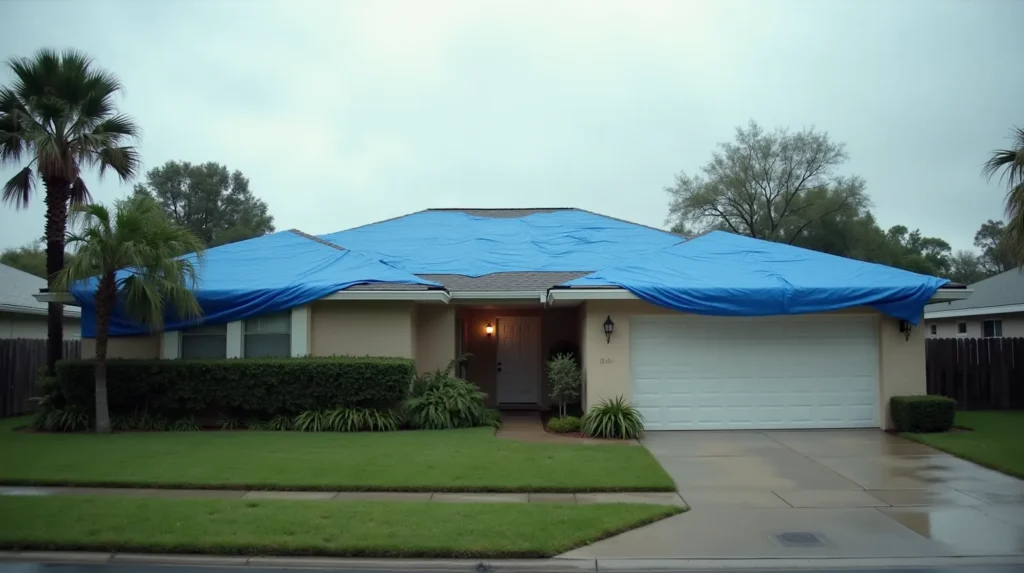
You filed a claim — roof damage from last spring’s hail, a pipe that burst in January, or a kitchen fire that left soot above the cabinets. The adjuster is still working the numbers, or the check has not cleared yet. Now you need to sell the house. You need to know two things: can you sell while the claim is open, and what happens to the insurance money?
The sale can proceed. What happens to the money depends on how you sell and which state you’re in.
Can you sell a house with an open insurance claim?
Yes. Tennessee, Florida, and Texas all allow a home sale to close while a property insurance claim is pending. You must disclose the damage and the claim status — hiding a known claim creates post-closing liability that costs far more than the disclosure itself. But the open claim does not stop the transaction.
The complication is financial, not legal. When you sell with an open claim, three things are in motion at the same time:
- your insurer still owes you money for the covered damage
- your mortgage lender has a financial interest in those proceeds
- the buyer needs homeowners insurance to close — and the claim history on the property can block that
Does selling the house cancel the open insurance claim?
No. The insurance claim belongs to you as the named insured, not to the property address. When you sell and close, you are no longer the homeowner — but you are still the claimant on the policy you paid for. The claim survives the transfer of title and continues as yours to settle. You collect after closing.
What the CLUE report does to a buyer’s insurance application
Every claim you file goes on the C.L.U.E. (Comprehensive Loss Underwriting Exchange) report attached to your property’s address. When a buyer applies for homeowners insurance before closing, the insurer pulls the CLUE history on that address. It follows the house — not the owner — for seven years.
A single large claim — a $38,000 roof replacement from wind damage, for example — signals elevated risk to the new buyer’s insurer. Some carriers will still write the policy. Others decline. In Florida, Citizens Insurance can deny a new application on a property with a recent large claim. If the buyer cannot obtain coverage, they cannot get a mortgage, and the deal collapses at the financing contingency.
This is the most common way an open claim disrupts a conventional sale. The claim is not the problem — the CLUE entry is the problem.
Cash buyers do not need homeowners insurance to close. Buying as-is removes the CLUE barrier from the transaction entirely.
Who controls the insurance money when you sell?
If you have a mortgage, the insurer typically makes the check payable to you and your lender jointly. Your lender then has two options:
- hold the proceeds in escrow and release them in draws as repairs are verified
- apply the insurance money to your outstanding loan balance instead of releasing it for repairs
If you close on a cash sale before the claim settles, the mortgage is paid off at the title table. Any insurance payment that arrives afterward goes directly to you — the lender no longer has a lien on the proceeds.
Can I keep the insurance money if I sell my house as-is?
Yes. Here is the structure: sell the house at a price that reflects the unrepaired condition, close, pay off the mortgage, and collect from the insurer on your own timeline. The buyer takes the property in its current state. You take the insurance money.
This is not a loophole. It is how insurance law functions when the claimant and the property owner are the same person: the claim is yours until it settles, regardless of whether you still own the house.
What if the claim is for fire damage?
The same mechanics apply. We covered the proceeds question in detail on the fire-damaged house page, including what happens when the insurer’s settlement and the cash offer arrive close together. The short answer: sell as-is, keep the claim, let the buyer deal with the restoration.
Tennessee: what the disclosure law requires
TCA § 66-5-202 requires disclosure of all known material defects, which includes the underlying damage and the open claim. The standard Tennessee residential disclosure form asks directly about prior damage and insurance history. A claim you know about and omit is a violation, and Tennessee gives buyers a right of action for non-disclosure.
Tennessee does not have a law that prohibits assignment of homeowners insurance claims. If a seller and buyer agree to transfer the claim, and the policy permits it, the structure can be documented. In practice, most Tennessee mortgage servicers and insurers are not set up to process claim transfers cleanly, and cash buyers have no reason to take on that complexity — they price the condition into the offer instead.
Older Nashville stock — Germantown, East Nashville, Madison, and Inglewood — sees frequent hail and wind claims. If you have a pending claim on a 1920s–1970s property in one of those neighborhoods and need to move on a deadline, a cash offer with the claim retained is often the cleaner path than waiting on the adjuster.
Florida: what HB 837 changed for sellers
Florida passed HB 837, effective July 1, 2023. FL § 627.70152 eliminated post-loss assignment of benefits for homeowners property insurance claims arising on or after that date. Sellers can no longer transfer open claim rights to a buyer using an Assignment of Benefits agreement — a structure some Florida sellers used before 2023 to hand the claim and the unrepaired property to the same buyer at once.
What is still available: sell as-is, accept a cash offer that accounts for the unrepaired damage, and keep the claim. The insurer owes you, and that obligation follows you after closing regardless of who owns the house.
In Pinellas, Hillsborough, Pasco, and Lee Counties — areas that absorbed direct hits from recent hurricane seasons — CLUE entries from storm damage claims are common and matter significantly to any financed buyer’s insurance application. When conventional buyers have walked because no carrier will write a policy on a property with multiple recent claims, cash is often the only path forward. For the broader Florida picture — including the judicial foreclosure timeline that sometimes runs alongside unresolved storm damage — see our Florida page.
Texas: disclosure requirements and what it costs to get them wrong
TREC Form OP-H, Section 4, asks sellers directly about insurance claims on the property in the last five years. Under TX Property Code § 5.008, failing to disclose a known claim is a statutory violation that creates real post-closing exposure — more expensive than the conversation you were avoiding.
Texas Insurance Code Chapter 542A (2017) was written to limit post-loss assignment of benefits for property claims, so the pre-HB 837 Florida-style claim transfer is not available in Texas either.
Dallas-Fort Worth is one of the highest-hail-frequency metropolitan areas in the United States. A pending roof claim from a hail event is common in DFW, and financed buyers’ lenders routinely condition loan approval on the roof being replaced and inspected before funding — pushing the close date out 3–6 weeks past contractor completion, not past contract signing. For sellers racing a foreclosure date while a claim is also open, that timeline is not workable.
When you should not sell to us
If you have time and a fully-covered loss, waiting to collect and repair before listing usually produces a better net. Here’s when that math works in your favor:
- the insurer accepted the claim and will pay for full repairs
- you have 60 or more days before you need to close
- repairs can be completed within 4–6 weeks
- the post-repair market value in your neighborhood puts you well ahead of a cash as-is price
In that case: collect, repair, and list with an agent. Your net will be higher than what we can offer.
We are the right call when:
- the claim is disputed and may take months to settle
- you need to close before the claim resolves — a job start date, a divorce settlement, a foreclosure auction
- the open claim is one of several problems on the property
- financed buyers have already backed out because of insurance underwriting problems
Straight answers
Do I have to disclose an insurance claim when selling?
Yes, in all three states. TCA § 66-5-202 (Tennessee), FL § 689.261 (Florida), and TREC Form OP-H under TX Property Code § 5.008 (Texas) all require disclosure of known material defects, which includes prior damage and open claims. Omitting a known claim is a material non-disclosure in all three states.
Can a buyer get homeowners insurance on a house with an open claim?
Sometimes, depending on the insurer, the claim size, and the state. Large claims — especially roof or water damage in Florida — frequently trigger declinations from standard carriers. Citizens Insurance Florida has explicit underwriting guidelines that exclude properties with recent large claims. A buyer who cannot get a policy cannot get a mortgage. Cash buyers have no coverage requirement, so the underwriting hurdle is not part of their transaction.
What if the insurer pays more than expected after I’ve already sold?
The additional payment is yours. The cash buyer purchased the house in its unrepaired condition — their offer was for the property, not the insurance proceeds. Your agreement with the insurer is separate from the sale contract. Whatever the insurer ultimately pays goes to you, regardless of when it settles.
Here’s what happens next
Give us the address. Let us know a claim is open. We look at the property in its current condition — not what it would be worth after repairs — and you have a cash offer within 24 hours.
No obligation to accept. If you do, we close in 7 to 14 days. The claim stays in your name. You collect from the insurer on your own schedule, after you have already moved on.
No repairs. No commissions. No fees. Call us at (615) 780-7349 or enter your address on this page.
Keep reading
- Selling a Vacant House: What It Really Costs to Wait
- Selling a House With a Private Well
- Sell a Fire Damaged House Fast for Cash
- Selling a House With Title Problems
- Best Home Offer Today Reviews: In Sellers’ Own Words
- Selling a House with a Damaged Roof
Ready for a number? Get your cash offer or call (615) 780-7349.