


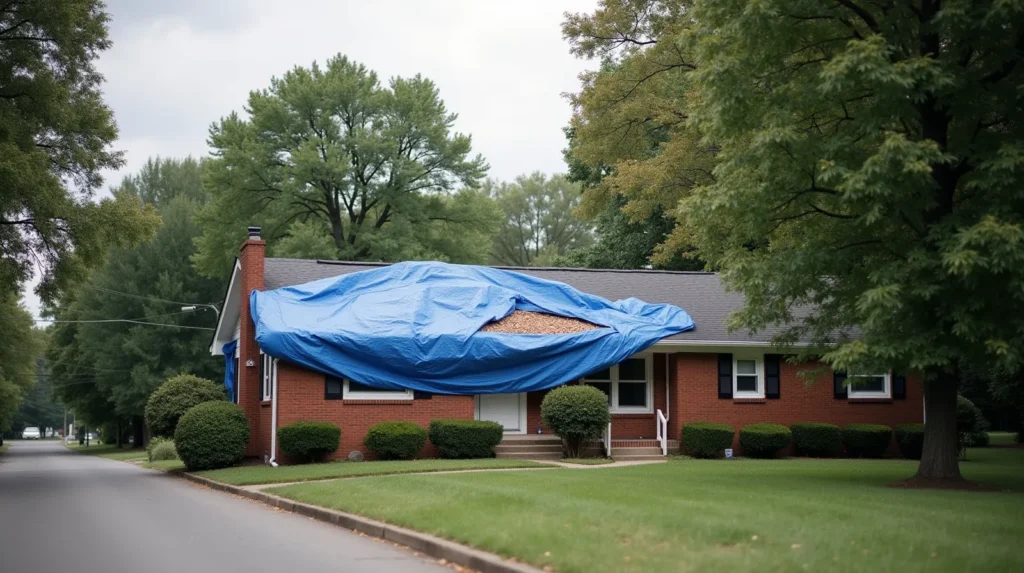
You filed the claim after the hailstorm, or the pipe burst, or the roof blew in the last hurricane. Now you need to sell. The question is whether that open claim locks you in place.
It doesn’t — but it does close off most of your buyers. Every person who needs a mortgage is effectively blocked until the claim resolves and repairs are certified complete. Understanding exactly why is the first step to making a clear decision.
Short answer: You can sell with an open claim. A lender won’t fund a mortgage on a property with unresolved material damage — so conventional buyers are blocked. You have three paths: wait for the claim to settle and repairs to finish, assign the insurance benefits to the buyer, or take a cash offer now. Each has a different price and timeline. None is automatically right.
Why a lender won’t close on a house with an open claim
When a buyer finances a purchase, the lender orders an appraisal before funding. If the appraiser finds unrepaired damage — a storm-battered roof, water staining on ceilings, boarded windows — they flag it as a repair condition. The loan goes into suspension. Funds don’t release until a licensed contractor completes the work and the appraiser signs off.
FHA loans follow HUD Handbook 4000.1, Section II.A.3, which requires that a property meet Minimum Property Standards at the time of appraisal. Unrepaired damage from a pending claim fails that standard. VA loans work the same way — VA Pamphlet 26-7, Chapter 12 requires minimum property requirements to be met before the VA guaranty issues. Conventional Fannie/Freddie loans give underwriters more discretion, but most lenders will require either proof of settled repairs or a repair escrow held at closing. Most sellers can’t fund that escrow on short notice.
The result: a buyer who goes under contract may have to walk, or the deal sits in limbo while you wait months for the adjuster.
The second wall: the CLUE report and the buyer’s insurance
Even buyers who survive the appraisal condition hit a second problem. When a buyer applies for homeowners insurance, their carrier runs a C.L.U.E. (Comprehensive Loss Underwriting Exchange) report on the property address. This report shows seven years of claims — including claims still open and unresolved.
A carrier that sees an active, unsettled claim may decline coverage, issue a policy with exclusions for the claimed damage, or charge significantly higher premiums. Without a new policy bound at closing, the buyer’s lender won’t fund. Even a fully repaired property carries the claim history; an unresolved one makes the insurance hurdle harder still.
A cash buyer steps around both walls. No lender. No appraisal condition. The CLUE report doesn’t block a cash purchase the way it blocks a financed one — the buyer takes on the insurance situation themselves after closing.
Three ways to structure a sale with an open claim
Wait for the claim to settle, complete repairs, and then list
This path puts the most money in your pocket if you have time. Once the insurer issues final payment, repairs are certified complete, and the CLUE report shows a resolved claim, conventional buyers can proceed without restriction.
Realistic timeline: adjusters typically take 30 to 90 days on a standard property claim, longer for contested losses or catastrophic events. Add 2 to 6 weeks for licensed contractor work. You are looking at 60 to 120 days before the house is truly sale-ready.
If you can carry the property that long, this often produces the best net. The honest caveat section below has the actual math.
Assign the insurance benefits to the buyer
An assignment of benefits (AOB) transfers your right to collect on the claim to the buyer. They take the property with the open claim, eventually receive the insurance payout, and handle the repairs themselves.
In theory this works cleanly. In practice two complications arise: (1) Florida has largely prohibited residential AOB under SB 7028 — see the state section below; (2) most mortgage lenders won’t accept it. The assignment doesn’t satisfy the appraisal repair condition. The lender still requires completed repairs before funding.
AOB is most practical with cash buyers, who have no lender to satisfy.
Reduce the price, retain the claim
The seller keeps the right to collect the insurance payout. The purchase price drops by an agreed amount reflecting the unrepaired damage. The buyer closes knowing the damage exists, handles repairs from their own funds, and the seller collects the insurance proceeds after closing — sometimes weeks or months later.
This requires a buyer willing to front repair costs. Lenders still won’t fund without completed repairs. This path works for cash transactions.
What a cash transaction with an open claim looks like
No lender. No appraisal condition. No CLUE report blocking at closing. The transaction is simpler and more certain than anything involving a mortgage.
What a cash sale with an open claim requires:
- Full written disclosure — claim number, insurer, adjuster contact, current status
- The scope-of-loss document — the adjuster’s full itemized estimate, not a summary email
- Payments already received and what they covered (ACV payment, depreciation holdback, any supplements paid)
- Whether the claim is active, contested, in the insurance appraisal process, or in litigation
- Repair status — what has been done, by whom, what remains unfinished
The offer reflects all of that. An uncontested hail claim with a clean adjuster estimate is a straightforward discount to negotiate. A contested total-loss claim with litigation pending is a more complicated conversation and a slower one.
We have bought more than 100 houses. Open claims come up regularly: hail events in Tennessee and Texas, hurricane damage in Florida, water losses that weren’t repaired before circumstances changed. The cleaner the documentation on the claim, the faster the transaction and the better the offer.
| Path | Timeline to close | Financed buyers available | Effect on price |
|---|---|---|---|
| Wait, repair, list with agent | 90 to 150 days | Yes | Minimal — full market value after repair |
| Assign claim, accept financed offer | 45 to 75 days | Unlikely — lender still requires repairs | Small discount for buyer’s uncertainty |
| Cash offer on open claim | 7 to 14 days | No | Moderate discount reflecting unrepaired damage |
When a cash buyer is not the right answer
If your equity is meaningful, the claim is straightforward — a standard hail-damaged roof rather than a contested partial-loss — and you have 90 to 120 days before your situation becomes urgent, waiting usually produces a better outcome.
Here is the honest comparison: a house worth $300,000 after repair, with a $25,000 open roof claim, might draw a cash offer of $260,000 to $270,000 — the buyer factors in their cost to resolve the damage. The gap between that offer and a conventional sale — minus agent commission, with repairs covered by insurance — is real. Three to four months of carrying costs might run $6,000 to $8,000. The gap is typically still wider than the carrying cost.
Waiting makes less sense when:
- The claim is disputed or in insurance appraisal — resolution is months away, not weeks
- You can’t cover carrying costs while the claim drags out
- The damage is extensive enough that completing repairs before sale isn’t practical
- There is a deadline — foreclosure auction date, job relocation, probate court order, divorce decree
- The property has other issues that would complicate a conventional sale regardless — see our guides on foundation problems and unpermitted work
State rules that change the calculation
Florida — the most complicated insurance environment in the country
Florida’s property insurance market creates complications for sellers that don’t exist in other states.
Assignment of benefits reform (SB 7028, 2023): Florida’s legislature substantially ended contractor-driven AOB abuse in 2023. Under current law, most residential property insurance policies must include an anti-assignment clause. You may not be able to legally assign an open claim to a buyer. Before structuring any sale around AOB, review your exact policy language and confirm with your insurer or a Florida attorney. Attempting to assign a claim your policy prohibits assigning creates liability.
Citizens Insurance: Florida’s insurer of last resort has its own inspection requirements and mandatory transfer processes. If the property carries a Citizens policy, disclose that early. The new buyer faces their own Citizens eligibility assessment, and many lenders won’t accept Citizens as the insurer of record.
CLUE and storm history: Properties with multiple hurricane or tropical storm claims in the past seven years may find private insurers unwilling to write new coverage at any price, pushing buyers into Citizens — which creates its own mortgage complications. In Miami-Dade, Broward, Palm Beach, Hillsborough, and Pinellas counties, this is a real barrier to conventional sales on storm-affected properties.
Florida seller disclosure (FL section 689.261): You are required to disclose known material defects. An open insurance claim for structural or water damage is material. Document it in writing on the seller’s disclosure before any accepted offer.
Tennessee — non-judicial state, full disclosure required
Tennessee does not have Florida’s anti-assignment restrictions. AOB is generally enforceable under standard policy language here, though your individual policy controls — read it before assuming.
Tennessee disclosure (TCA section 66-5-202): Tennessee’s Residential Property Condition Disclosure requires disclosure of known material defects and prior damage. An open insurance claim is disclosable. Middle Tennessee — Davidson, Williamson, Rutherford, and Sumner counties — sees consistent hail and tornado events each spring and fall. A pending storm claim on a pre-1990 house in East Nashville, Brentwood, or Smyrna is a common situation, and the disclosure obligation is unambiguous.
Tennessee also uses a non-judicial foreclosure process. If a foreclosure date is running alongside an open claim, the 7-to-14-day cash close becomes more significant — you have until the auction gavel, not until the insurer eventually settles.
Texas — hail capital, prompt payment deadlines, mandatory disclosure
The Dallas-Fort Worth area records more insured hail losses per square mile than nearly anywhere in the country. Open hail claims are a routine feature of Texas real estate transactions — DFW, San Antonio, the Austin-to-Waco corridor, and the Panhandle all see heavy hail seasons regularly.
Texas seller disclosure (TREC Form OP-H, Section 3): The Texas Seller’s Disclosure Notice asks directly whether there is a current insurance claim on the property. You disclose it and describe it. This is mandatory under Texas Property Code section 5.008.
Texas Insurance Code section 542 — prompt payment deadlines: If your insurer has been slow, Texas law requires acknowledgment within 15 days of filing and acceptance or denial within 15 days of receiving all required documentation. If the insurer has missed those deadlines, document it. That documentation has practical value: a delayed claim extends your timeline, which affects carrying cost and what price makes sense to accept in a negotiation.
TREC Form OP-H also asks about prior insurance claims going back four years. If there have been multiple claims on the same property — hail, then another hail, then a water claim — that history appears on the CLUE report and affects any conventional buyer’s insurability. Disclose what you know.
What to have ready before any buyer conversation
- Claim number and the insurer’s current contact for the file
- The full scope-of-loss estimate from the adjuster — the itemized document, not a summary
- ACV payment received and any depreciation holdback amount still outstanding
- Current claim status: open, supplemental filed, in insurance appraisal, or in litigation
- Repair status: what has been done, by whom, what remains
A buyer considering a property with an open claim needs to understand the path to resolution. A complete, organized file closes faster and at a better price than “I’ll have to call the adjuster.”
Straight answers to common questions
Can I keep the insurance payout if I sell before the claim settles?
In most cases yes — if you structure the sale as a price reduction and retain the claim rather than assigning it. You sell at a reduced price reflecting the damage, the buyer takes the property as-is, and you collect the insurance proceeds after closing. In Florida, the anti-assignment reform adds complexity — consult an attorney before relying on this structure there.
Does the buyer inherit my claim?
Only if you assign it. The underlying claim belongs to whoever held the insurable interest at the time of the loss — you, the seller. A buyer who purchases after the loss date cannot assert a new claim for that event. If you sell without assigning, the claim remains yours to collect. Undisclosed damage creates serious liability here: if you had an open claim and didn’t disclose the underlying damage, you have given the buyer grounds for a fraud claim later.
What happens to an assigned claim after closing?
The buyer becomes the claimant and deals with the insurer directly. Notify your insurer immediately of the assignment and change in ownership. Any remaining work — inspections, supplements, final payment — flows through the buyer. The insurer’s file updates to reflect the new party.
Can I sell if my insurer is disputing the claim?
Yes. A disputed claim doesn’t prevent a sale — it narrows your options further. A cash buyer can still purchase, knowing the claim is contested and factoring that uncertainty into the offer. If the dispute is in the insurance appraisal process, that has a defined timeline. If it’s in litigation, the uncertainty is real — disclose it fully and expect the buyer to price in the risk.
Get a number before you decide anything
You don’t have to choose between waiting four months for the claim to close and accepting whatever a cash buyer offers without knowing your alternative. Get the offer first. If the discount is small relative to your carrying cost and deadline pressure, you have a real decision to make with real numbers. If the gap is large, you know waiting is worth it.
We buy houses across Tennessee, Florida, and Texas with open claims, deferred repairs, and the situations that close off the conventional market. Call us at (615) 780-7349 or enter the address below for a cash offer within 24 hours — no agent fees, no obligation.
Also see: selling a fire-damaged house · selling a house with smoke damage · how to sell a house as-is · we buy houses in Florida · selling a house with water damage