


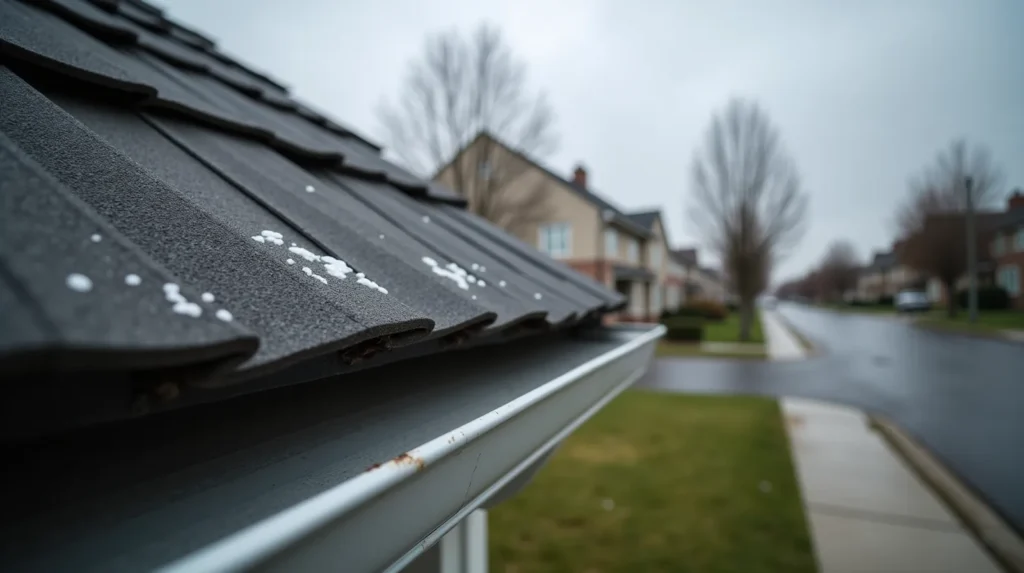
A hailstorm does not ask for your schedule. One storm can leave you with a dented roof, cracked siding, broken gutters, and a decision you didn’t plan for: file a claim, fix everything, and list with an agent — or sell the house as-is and walk away.
Neither path is wrong. But they lead to very different timelines and very different numbers on the closing statement.
Hail damage triggers a repair condition on FHA and VA appraisals. Filing an insurance claim creates a seven-year record that follows the property. Cash buyers buy as-is, skip the appraisal entirely, and close in 7–14 days. If you have time and a clean insurance payout, the agent route likely nets more money — but only if everything goes smoothly.
What hail damage actually does to a sale
Hail damage has two layers that matter once you’re trying to sell: the physical condition of the property and the insurance record attached to it.
The physical condition. Visible hail strikes on a roof — cracked shingles, dented decking, compromised flashing — trigger a repair condition on FHA and VA appraisals. Under HUD 4000.1 §II.A.3.b(iv), a roof must have at least two years of remaining useful life for an FHA-backed lender to fund. Hail damage that has shortened that life expectancy fails the standard. Until a contractor makes the repairs and a reinspection clears the appraisal, FHA and VA buyers cannot close. Conventional buyers can still close if their lender accepts the condition — but many conventional lenders have their own overlay requirements that treat hail damage the same way.
For more on how the FHA roof standard works in practice, see our guide on selling a house with roof problems.
The insurance record. If a claim has been filed, it appears on the CLUE (Comprehensive Loss Underwriting Exchange) database for seven years. Any insurer can pull the CLUE report on a property before writing a new policy for the buyer. In markets where carriers are already tightening underwriting — most of Florida and the Texas hail belt — a prior claim can be the extra strike that pushes an application into decline. No insurance binder means no mortgage. That removes financed buyers entirely.
The two combine to shrink your buyer pool to conventional-financed buyers who can clear appraisal and get coverage, and cash buyers who skip both.
Should you file the insurance claim before you sell?
That depends on which path you’re taking.
If you plan to repair and list: file the claim. Your homeowner’s policy exists for exactly this situation. Get the payout, do the repairs, and list after reinspection. The CLUE record is not a hidden trap here — it shows a claim was filed and repairs were made, which is the normal sequence buyers and agents see all the time.
If you plan to sell as-is to a cash buyer: you do not need to file first. Filing creates the CLUE record without delivering the repair, since the house sells before any work happens. Some sellers file, receive a partial payment, then negotiate the remaining damage into the price. That is legal, but the math rarely beats negotiating the damage into the cash offer directly.
What you cannot do is sell with undisclosed known damage. In Tennessee, TCA § 66-5-202 requires disclosure of known material defects. In Texas, TREC Form OP-H Section 3 requires disclosure of roof damage and prior insurance claims — non-disclosure creates DTPA liability. In Florida, Statute § 689.261 requires disclosure, and SB 7028 (2023) added a five-year prior-claim disclosure obligation on top of that. Hail damage you know about is a material defect in all three states.
For details on the open-claim scenario specifically, see our guide on selling a house with an open insurance claim.
Texas: where hail is a routine part of real estate
DFW is the most hail-struck major metro in the United States. Lubbock, Abilene, San Angelo, and the I-35 corridor north of Austin sit inside the National Severe Storms Laboratory’s documented hail belt. A house more than ten years old in Collin, Denton, or Tarrant County has almost certainly taken at least one significant storm.
Buyers in Texas are familiar with hail history on a property — but FHA and VA lenders still require clear appraisals, and the repair condition applies the same as anywhere else. State Farm and other carriers in the Texas hail belt increasingly underwrite based on the CLUE history of the property, not just current condition. A home with two or three prior hail claims over the past decade may be declined by standard carriers regardless of repair status. That closes out most financed buyers.
For sellers on a hard deadline — Texas Property Code § 51.002 gives 41 days from posting to trustee’s sale with no right of redemption — a cash close in 7–14 days is the only option that fits the clock.
We buy houses throughout Texas. If you’re in DFW, Houston, San Antonio, or anywhere in the hail belt and want a straight answer on what the house is worth as-is, see our Texas cash home buying page or put the address in the form below.
Florida: hail plus hurricane means layered insurance problems
Florida hail is less common than Texas hail but often arrives alongside hurricanes and tropical storms. The complication is Citizens Insurance — Florida’s insurer of last resort — which conducts four-point inspections before writing new policies. A roof with visible hail or wind damage receives a D or F grade and triggers a policy decline. No policy means no mortgage.
Florida requires disclosure of storm damage under § 689.261. SB 7028 (2023) adds a five-year prior insurance claim disclosure requirement. A buyer will see any claim on file.
In coastal flood zones where a storm also brought surge or flood damage alongside the hail, FEMA’s Substantial Damage rule applies: if repair costs exceed 50 percent of the pre-storm assessed value, the property may require elevation before reconstruction. That adds months and significant cost to the fix-and-list path. We work throughout Florida — see our Florida cash home buying page for more on how the state’s insurance and foreclosure dynamics affect sellers.
Tennessee: when the foreclosure clock and the repair cycle conflict
Middle Tennessee — Nashville, Murfreesboro, Clarksville, Hendersonville — sees regular convective hail seasons. Rutherford, Wilson, Williamson, and Sumner Counties take storms on the typical track east of Nashville.
Tennessee non-judicial foreclosure under TCA § 35-5-101 moves in 60–90 days with no redemption period after the trustee’s deed records. If you’re behind on mortgage payments and hail damage is sitting unrepaired, the lender’s timeline and the repair cycle don’t fit together. A contractor won’t start until the insurance adjuster comes out. The adjuster may take two to six weeks. Repairs take four to eight weeks after that. The foreclosure sale date may land before any of that completes.
Cash buyers work differently. We give you an offer within 24 hours of getting the address, close in 7–14 days, and you pick the date.
Three paths, with real numbers
| Path | Typical timeline | Net on a $280k home with $18k damage | Main risk |
|---|---|---|---|
| File claim + repair + list with agent | 3–5 months | ~$247k–$258k (after 5–6% commission, minus deductible) | Reinspection delays, deal falls at appraisal, market shift |
| List as-is with disclosed damage | 45–90 days | ~$245k–$255k (discount priced in, buyer handles repair) | Financing contingencies, smaller buyer pool |
| Cash buyer, as-is | 7–14 days | ~$236k–$250k | Lower net than repair + list path |
The gap between path one and path three is roughly $8k–$22k on a $280k home. Whether that gap is worth 3–5 months of carrying costs, the risk of a lender reinspection failing, and the uncertainty of a financed buyer’s appraisal contingency depends entirely on your situation.
When you probably should not call us
If the damage is limited to the roof, your insurer is paying a reasonable claim, a contractor can start in the next four to six weeks, and you have no payments past due — fix the roof and list with an agent. You’ll likely net $10k–$20k more.
The cash path makes more sense when:
- You’re behind on payments and can’t absorb a 3–5 month repair-and-list cycle
- Your insurer is disputing the claim or the payout is slow
- You’re in a high-risk insurance county in Florida or the Texas hail belt and financed buyers are being declined coverage
- The damage is layered — hail plus deferred maintenance plus age — and the repair cost approaches what the market would return
- You’re an executor or heir trying to close out a property on a court timeline
If none of that fits your situation, an agent is probably the right call. We’ll tell you that directly if you ask.
How it works after you submit the address
You give us the address and a brief description of what the storm left. We have a cash offer to you within 24 hours — no inspection required before the offer. If you accept, we set the closing date: 7 to 14 days, or later if you need more time. We’ve bought more than 100 houses. We handle the paperwork. No commissions, no fees, no closing costs.
Call us at (615) 780-7349 or put the address in the form.
Straight answers
Does hail damage automatically fail an FHA appraisal?
Not automatically, but visible damage to the roof that affects its remaining useful life will trigger a repair condition. HUD 4000.1 §II.A.3.b(iv) sets a two-year minimum remaining life standard. If the appraiser estimates less than two years of life remaining due to hail damage, the lender requires repairs before funding.
What if I don’t file an insurance claim before selling?
You can sell without filing. You are required to disclose known damage under TCA § 66-5-202 (TN), TREC Form OP-H (TX), and FL § 689.261 regardless. Without a filed claim there’s no CLUE record from this storm — which is neutral to the buyer’s insurability — but you also forfeit any payout. Cash buyers price the known damage into the offer.
Will the buyer’s insurer see prior hail claims on the house?
Yes. CLUE reports are pulled on the property, not the person. Any insurer writing a new policy for the buyer will see claim history going back seven years.
Can I sell a house with an open hail damage claim?
Yes. An open claim can be assigned to the buyer, negotiated into the price, or withdrawn. Cash buyers typically don’t require you to resolve the claim before closing. See our guide on selling with an open insurance claim for the full breakdown.
Keep reading
- Selling a House with Foundation Problems: Your Real Options
- Can I Sell a Condemned House?
- Selling a House with Mold: What You Need to Know
- Sell My House Fast in Fishers IN — Cash Offer in 24 Hours
- Sell My House Fast in Conroe, TX
- Sell My House Fast in Brandon, FL — Cash Offer in 24 Hours
Ready for a number? Get your cash offer or call (615) 780-7349.