


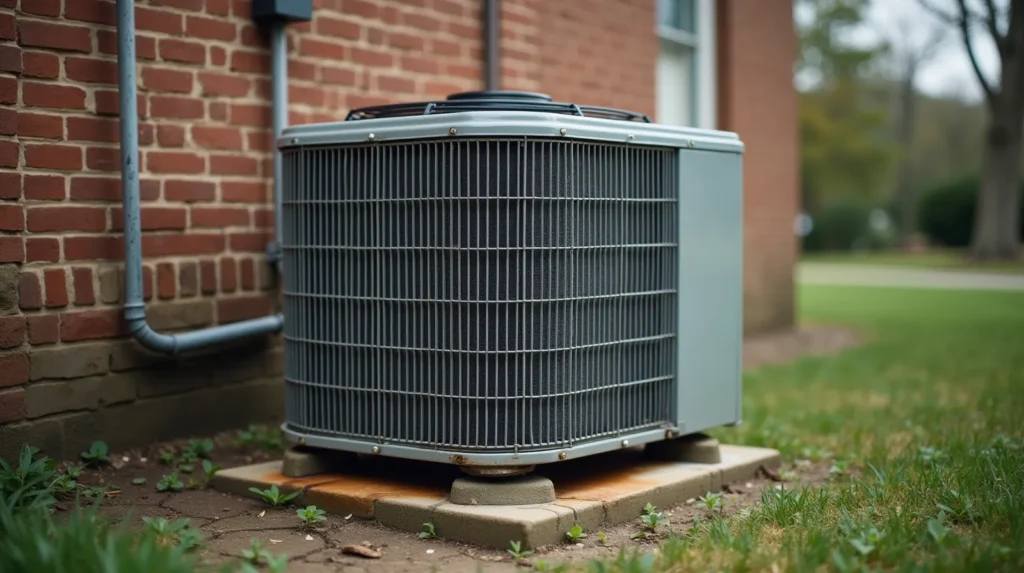
Your HVAC system failed. Now what?
A furnace that goes out in January or a central AC that quits in a Texas summer does not just make the house uncomfortable. It can stop a financed sale entirely. A lender’s appraiser is required to flag non-functioning HVAC as a repair condition, which means no loan funds until you either fix it or the buyer walks.
Cash buyers have no appraiser. The condition gets priced into the offer and the sale moves on. Whether fixing and listing makes more financial sense depends on the age of the system, your timeline, and what else is deferred. This page covers both paths honestly.
Short answer: Yes, you can sell a house with broken or failing HVAC. If you go the agent route, the appraiser will flag it and the lender will require repair before funding. If you sell to a cash buyer, you skip the appraisal condition entirely. The right choice depends on the numbers and your timeline.
Why HVAC problems kill financed sales
Under HUD Handbook 4000.1 §II.A.3.b(vi)(B), the FHA appraiser must note if the heating system cannot maintain 50°F in rooms containing plumbing. If it cannot — or if the system is visibly non-functional — it becomes a lender-required repair condition. The loan does not fund until the seller provides a contractor certification that the system is operational and serviceable.
The VA follows the same standard under VA Pamphlet 26-7, Chapter 12. Fannie Mae and Freddie Mac conventional guidelines do not publish a specific temperature floor, but their appraisal forms require the appraiser to note mechanical systems that are “visibly deficient.” An HVAC system that is not running during the inspection visit gets noted. The underwriter then conditions the loan on repair.
This creates a hard stop in any timeline-sensitive situation. A repair credit alone does not satisfy the lender condition on an FHA or VA loan. The physical repair — with contractor certification — does.
The Florida four-point inspection layer
In Florida, there is a second mechanism that does not apply in most other states. Citizens Insurance and many private Florida carriers require a four-point inspection on homes 25 years or older before binding a new homeowners policy. The four-point covers roof, electrical, plumbing, and HVAC.
An aging HVAC system — typically anything over 15 to 20 years depending on the insurer — will receive a D or F grade on the HVAC section. That grade causes the carrier to either decline to bind the policy or surcharge it heavily. Without homeowners insurance in place at closing, a lender will not fund the mortgage.
This means a Florida buyer with a conventional loan can be blocked by HVAC age even if the system is technically still running. The four-point is a carrier underwriting tool, not an FHA appraisal requirement, and it runs a stricter standard than the federal one. Cash buyers skip both: no lender, no insurance requirement at closing. If you are selling a home in Pinellas County, Lee County, or Hillsborough County, the four-point is nearly certain on any home built before 2000. See also how we buy houses in Florida for the full picture on Florida foreclosure timelines and the Citizens Insurance market.
Texas: disclosure and the summer showing problem
TREC Form OP-H Section 7 asks sellers directly whether heating and cooling equipment is operative. A non-functional system requires a No answer before any buyer sees the property. That disclosure alone narrows the showing pool to investors and cash buyers — most financed buyers will include a repair contingency or exit the contract after inspection.
In August, a Dallas or Houston home that cannot be cooled below 90°F is functionally unshowable to most buyers. The practical showing window collapses to early mornings before the heat builds. Cash buyers, accustomed to evaluating properties in their actual condition, are the realistic pool.
Texas non-judicial foreclosure moves fast under Property Code § 51.002: 20-day cure notice and 21-day notice of trustee’s sale puts an auction date 41 days out with no right of redemption afterward. If HVAC failure is part of a broader financial situation, that clock moves faster than a repair-and-list timeline.
Tennessee: heating adequacy and winter timelines
Nashville winters drop below 20°F several times each season. A non-functional furnace fails the HUD 4000.1 heating adequacy standard even on a conventional appraisal. A home listed in November or December with a failed furnace will not reach closing on a financed deal without repair.
Under TCA § 66-5-202, a known non-functional HVAC system is a material defect and must be disclosed. The East Nashville, Germantown, and Waverly-Belmont pre-1960s housing stock carries a disproportionate share of original or first-replacement forced-air systems — these are the homes where a 30-year-old furnace fails at the moment of listing and where replacement costs often exceed what the math justifies.
TN non-judicial foreclosure under TCA § 35-5-101 runs 60 to 90 days from first default to courthouse auction. If a seller is carrying both a non-functional furnace and a delayed payment history, the timeline for repair-and-list does not close before the trustee’s sale date.
The cost math — replace or sell as-is
A new central AC-only system runs $5,000 to $12,000 installed. A full heat pump or gas furnace and AC combination runs $10,000 to $20,000, rising for larger homes. Since January 2023, the Department of Energy’s SEER2 transition means older-spec units are no longer available — replacement systems now meet higher efficiency standards at higher equipment costs.
Here is what the math looks like on a $260,000 home with a dead 18-year-old HVAC system:
| Path | HVAC cost | Agent commission | Carrying costs (3 mo.) | Estimated net |
|---|---|---|---|---|
| Replace and list with agent | $12,000 | $15,600 (6%) | $4,500 | ~$228,000 |
| Sell as-is to cash buyer | $0 | $0 | $0 | ~$215,000–$230,000 |
The gap between the two paths is narrower than most sellers assume — especially when the HVAC is one of several deferred maintenance items. If the HVAC is the only issue and repair (not replacement) is possible, the math tilts toward fixing and listing. If replacement is unavoidable and the house has additional deferred maintenance, the cash buyer math often lands within $10,000 to $15,000 of the agent-listing net — without four to five months of carrying the house. For context on how condition factors into our offer on as-is sales, the process is the same regardless of the specific defect.
Cash buyer vs. agent listing — a direct comparison
| Factor | Agent listing (HVAC repaired) | Cash buyer (as-is) |
|---|---|---|
| HVAC repair required before close | Yes — lender condition | No |
| Disclosure obligation | Yes (TCA § 66-5-202 / TREC OP-H / FL § 689.261) | Yes — same disclosure applies |
| FL four-point inspection issue | Must pass before carrier binds policy | No lender, no insurance required at close |
| Time to close | 45–90 days after repair completes | 7–14 days |
| Repair credit as substitute | Lender typically still requires physical repair | No lender, no condition |
| Showing while non-functional | Very limited in summer (TX) or winter (TN) | One walkthrough |
| Fall-through risk at inspection | High if HVAC reveals additional deferred items | No inspection contingency |
When you should not sell to us
If the HVAC system needs a capacitor, a contactor, or a refrigerant recharge — repairs in the $150 to $800 range — pay for the repair, get the system certified, and list with an agent. You will net more money.
If the system is under 12 years old and fully repairable for under $2,000, the math almost always favors fixing it. A mid-life HVAC that passes the appraisal and the FL four-point opens the full financed buyer pool, which supports a higher offer price than a cash-only pool can reach.
If you have 60 or more days, the house is otherwise in good condition, and replacement cost is the only issue, get two HVAC bids before calling us. A repair-and-list path may net you $10,000 to $20,000 more than any cash offer. We will tell you that directly when you submit the address.
A cash offer makes the most financial sense when: the system requires full replacement and the house has additional deferred maintenance, your timeline is under 30 days, you are carrying two properties, or the property is in Florida where the four-point insurance issue compounds the problem. If your house has other condition issues beyond the HVAC, the combined picture often changes the math substantially.
How it works when you submit
You give us the address. We have a cash offer to you within 24 hours. We buy houses as-is — the HVAC condition factors into the offer; it does not stop the process. You pick the closing date. We have bought more than 100 houses this way. No fees, no commissions, no repairs required.
If your HVAC failure is stacking with electrical system issues or other deferred maintenance, the process is the same — one walkthrough, one offer, one close. Give us a call at (615) 780-7349 or submit your address below.
Does HVAC condition affect a cash offer?
Yes. A cash buyer prices the condition into the offer — typically the estimated replacement cost plus contractor margin. The offer reflects the as-is value. It does not require you to fix anything first.
Can I sell a house in summer without air conditioning?
To a financed buyer, it is very difficult in TX or FL. The home is hard to show in extreme heat and lenders require the system to be functional before funding. Cash buyers inspect in the actual condition and do not require a working AC to make an offer.
Will the lender accept a repair credit instead of fixing the HVAC?
Most lenders will not accept a repair credit as a substitute for a lender-required repair condition on an FHA or VA loan. The physical repair must be completed and a contractor certification provided before the loan funds. A credit held in escrow does not satisfy this condition.
Does a non-functional HVAC have to be disclosed in Tennessee?
Yes. Under TCA § 66-5-202, a known non-functional HVAC system is a material defect and must be disclosed. The disclosure does not obligate you to repair it — but for financed buyers, the appraiser will flag it and the lender will condition the loan on repair regardless.
Why does Florida’s four-point inspection complicate HVAC sales?
Citizens Insurance and many Florida private carriers require a four-point inspection on homes 25 years and older before binding a new homeowners policy. An HVAC system over 15 to 20 years old typically receives a low grade, which can cause the carrier to decline coverage. Without coverage, the lender will not fund the mortgage — even if the FHA appraiser does not flag the system as non-functional.
Keep reading
- Can You Sell a House With Asbestos? Tennessee Guide
- Sell My House Fast San Antonio TX
- Sell My House Fast in St. Charles, MO
- How to Sell a Hoarder House (Without Cleaning It Out First)
- Sell My House Fast Lakeland FL — Cash Offer in 24 Hours
- Selling a House to Pay for Assisted Living
Ready for a number? Get your cash offer or call (615) 780-7349.