


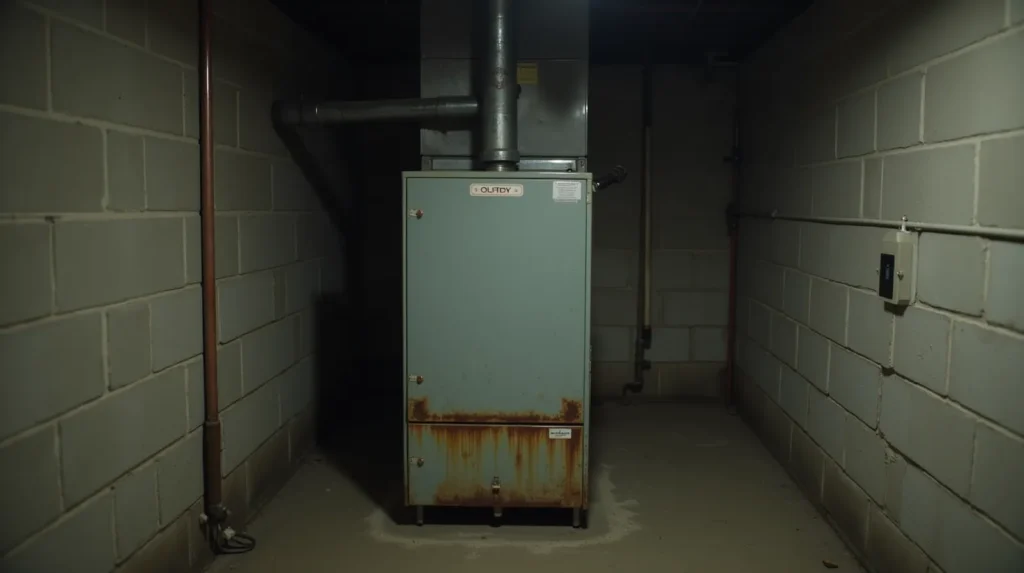
What a broken HVAC actually costs you when selling
A failed furnace or dead air conditioner doesn’t just make the house uncomfortable to show. It stops financed buyers from closing.
FHA and VA appraisers are required to check whether the heating system works. HUD Handbook 4000.1 §II.A.3.b is specific: the heating system must be safe, adequate, and capable of maintaining 50°F in all living spaces. If the furnace doesn’t run, the appraiser writes a repair condition. The lender doesn’t release funds until someone fixes it. Your closing date moves, or the buyer walks.
Cash buyers skip that step entirely. No appraiser, no repair condition, no delay. The broken HVAC gets priced into the offer and the sale closes anyway.
Quick answer: Yes — you can sell. A broken furnace or failed AC creates a lender repair condition that stalls most financed buyers. Cash buyers don’t use appraisals, so the condition gets priced into the offer and closing happens in 7–14 days. Call (615) 780-7349 or submit the address below.
How the FHA and VA appraisal barrier works
Most buyers use a mortgage. Most mortgages involve an appraisal. FHA and VA appraisers check mechanical systems — they don’t just assess value.
Under HUD 4000.1 §II.A.3.b, a non-operational furnace is a repair-required flag. The lender won’t fund until the repair is documented by a licensed HVAC contractor. In practice, the seller has two choices: replace the furnace before closing, or negotiate a credit so the buyer handles it post-close. Most lenders reject the credit option on a completely dead system — they require the repair done before releasing funds.
Conventional loans follow similar guidelines. Fannie Mae’s Selling Guide and Freddie Mac’s requirements both mandate working utilities and mechanical systems. A broken furnace in January fails that standard in nearly any market.
Why it plays out differently in Florida, Texas, and Tennessee
Florida: the insurance problem runs deeper than the appraisal
In Florida, the financing barrier often runs through insurance before it reaches the appraisal. Citizens Insurance — which covers a significant share of Florida homes — requires a four-point inspection before writing a new policy. The inspection grades the roof, electrical, plumbing, and HVAC on age and condition. A D or F on HVAC means the policy is denied. No policy means no lender commitment. No lender means no mortgage.
This plays out with particular force in Hillsborough, Pinellas, Broward, Miami-Dade, and Palm Beach counties, where Citizens Insurance market share is highest. A home in Tampa with a dead AC unit isn’t just harder to sell to a financed buyer — depending on the home’s age and insurer, it may be effectively unsalable to one until the system is replaced or an alternative policy is found at significantly higher cost. Florida § 689.261 requires disclosure of known material defects, including a non-functional HVAC system. Learn more about the Florida cash-sale market and how buyers price as-is properties there.
Texas: heat plus a mandatory disclosure
TREC Form OP-H Section 4 is Texas’s standard residential real property disclosure — HVAC is a named item, and sellers must disclose known defects. In Dallas, Houston, and San Antonio, where summer temperatures regularly reach 105–110°F, a dead AC system creates a practical problem independent of loan type: a home that cannot be cooled is effectively uninhabitable, and buyers can terminate during the inspection period when major systems don’t function.
Conventional lenders in South Texas often require working AC as a funding condition on homes in high-heat climate zones. TX Property Code § 51.002 gives a 41-day foreclosure timeline with no right of redemption. If a failed HVAC system is stalling a traditional sale while mortgage payments fall behind, the foreclosure clock doesn’t pause for HVAC repairs.
Tennessee: disclosure that carries forward
Nashville and East Tennessee get ice storms. A house without a working furnace fails the FHA 50°F minimum property standard in cold months. TCA § 66-5-202 requires disclosure of known material defects to every subsequent buyer — including buyers who never close. Once a buyer’s inspector finds the dead furnace and the deal falls through, you carry that disclosure obligation to the next buyer.
TCA § 35-5-101 et seq. governs Tennessee’s non-judicial foreclosure: after cure notice and three weekly newspaper publications, the county courthouse auction happens with no right of redemption. From first published notice to sale typically runs 60–90 days. If a broken HVAC is delaying a traditional sale while mortgage payments fall behind, both clocks are running at once.
What replacing HVAC actually costs
A gas furnace replacement runs $3,000–$7,000 installed in the Nashville area. Central AC unit replacement runs $3,500–$8,500 depending on tonnage. A complete system — furnace, AC unit, and air handler — typically costs $8,000–$14,000, higher in older homes where ductwork also needs work.
Add to that:
- Removal of the existing unit — often $300–$600, frequently excluded from base quotes
- County permit fees — $150–$500 in most Tennessee, Texas, and Florida counties
- Ductwork repairs — $500–$2,500 if the new system exposes duct problems
If the only issue with the house is a dead furnace in otherwise solid Nashville-area stock, replacing it and listing the property or working with an agent often makes financial sense. If the HVAC failure sits alongside a roof near end of life, a foundation crack, or failing plumbing, the calculation changes.
How a cash offer works on a house with broken HVAC
We price from ARV (the property’s after-repair value in the current market) minus estimated repair cost minus our margin. For a $260,000 ARV home in Nashville with a $10,000 HVAC replacement needed, that typically produces a cash offer in the $215,000–$232,000 range depending on overall condition and comparable sales.
| Path | Approximate net on a $260k ARV home |
|---|---|
| Replace HVAC ($10k) + list with agent (5–6% + closing costs) | ~$220k–$228k |
| Sell as-is to cash buyer | ~$215k–$232k |
| Cash sale with active foreclosure deadline | Cash closes it; traditional route often won’t |
The numbers are close on a well-maintained house where HVAC is the only issue. They diverge when HVAC is stacked with other repairs, or when a real deadline makes the repair-and-list path unavailable.
When we’re probably not the right call
If the system is aging but still runs, it won’t fail an FHA appraisal. Appraisers test whether the system operates — they don’t fail a property because the furnace is 12 years old. An old but functional system typically passes.
If the problem is a minor repair rather than a full replacement — a failed capacitor ($150–$400), a refrigerant recharge, a clogged filter — fix it. A working system removes the financing barrier entirely and reopens the full buyer pool.
If the HVAC is the only issue and the house is otherwise sound, list with an agent and offer a seller concession. You will likely net $10,000–$20,000 more than a cash offer on a clean, single-issue property.
A cash sale makes sense when the HVAC failure is complete and cannot be resolved on your timeline, when HVAC is one item on a list of several problems, or when a real deadline — foreclosure auction, estate creditor clock, job start date — makes 60–90 days of repairs and showings unavailable.
Corroded copper on air conditioning coils that fail again and again can point to something other than the HVAC system itself. In houses built or renovated in the mid-2000s, it is one of the signs inspectors associate with Chinese drywall.
Straight answers
Will a broken furnace fail an FHA appraisal?
Yes, if it fails to produce heat when tested. HUD 4000.1 §II.A.3.b requires a heating system capable of maintaining 50°F in all living spaces. A non-operational furnace triggers a repair condition that suspends loan funding until the repair is documented.
Does a broken AC fail a VA appraisal?
It depends on the market. In northern climates where AC is seasonal, a non-functional AC may not trigger a VA repair condition in winter months. In Florida and South Texas, VA appraisers regularly flag broken AC as a minimum property standards issue because year-round cooling is essential to habitability in those climate zones.
Can I sell as-is with a broken HVAC in Tennessee?
Yes. TCA § 66-5-202 requires disclosure, not repair. The constraint is buyer pool: most Tennessee buyers need conventional financing, and a broken furnace creates a lender repair condition that must be resolved before most mortgages fund. Cash buyers have no appraisal, so there is no repair condition to satisfy.
How fast can you close on a house with broken HVAC?
We can have a written offer within 24 hours of receiving the address. Closing typically runs 7–14 days from there. The HVAC condition doesn’t delay us the way it delays a financed buyer — there’s no appraisal, no repair condition, no lender hold on the transaction.
Do I have to disclose a broken HVAC to a cash buyer?
Yes. TCA § 66-5-202, TREC Form OP-H, and Florida § 689.261 all apply to every sale, including cash sales. Non-disclosure exposes you to post-closing litigation. Legitimate cash buyers price the known condition into the offer — that’s the honest transaction.