


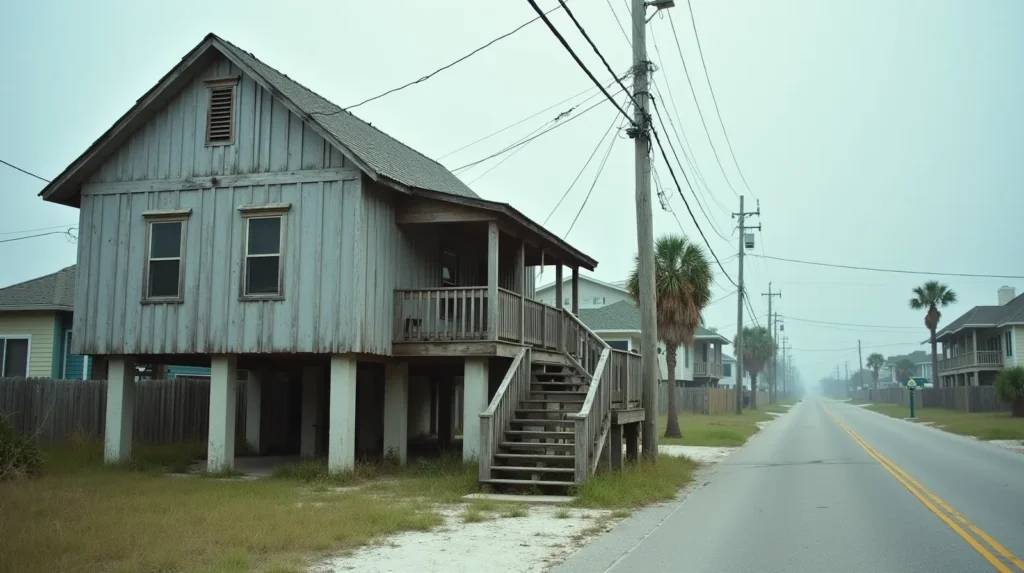
What makes Galveston properties hard to sell on the open market
Galveston is a barrier island. That geography shapes everything about selling a house here, and almost none of it works in a conventional buyer’s favor.
Most properties in Galveston carry two mandatory insurance requirements: NFIP flood coverage — required by any federally backed mortgage under 42 U.S.C. § 4012a for properties in a Special Flood Hazard Area — and windstorm coverage through TWIA, the Texas Windstorm Insurance Association. Private carriers stopped writing windstorm policies on the island after Hurricane Ike in 2008. TWIA picked up the book and has held it since.
Combined premiums run $8,000 to $18,000 per year on a typical beach-adjacent property. Add a mortgage payment to that, and the monthly carrying cost pushes buyers out of qualification on a $250,000 home. That narrowing of the buyer pool is why Galveston properties sit, or sell to investors who already carry those costs elsewhere.
For a financed buyer, both policies must be active before the lender closes. TWIA imposes a standard 30-day waiting period on new policies. A buyer who applies for windstorm coverage the day they go under contract is running a race they may lose — and the seller has no control over the outcome. If you need to understand what this means for any property in the state, see our overview of how we buy houses across Texas.
Hurricane Ike, elevation requirements, and the FEMA Substantial Damage trap
Ike made landfall September 13, 2008, with a storm surge of 15 to 20 feet across much of the island. FEMA issued Substantial Damage determinations on properties where repair costs equaled or exceeded 50% of the pre-storm market value. A Substantial Damage finding requires the structure to be brought into full compliance with current NFIP floodplain regulations — typically elevation to the Base Flood Elevation plus one foot of freeboard.
On Galveston Island, compliance means pilings. Lifting an existing structure onto a new piling foundation runs $40,000 to $120,000 depending on footprint, original construction, and soil conditions. Many owners repaired to livable condition without completing the elevation — deferred compliance. It surfaces as a problem when a lender orders an elevation certificate and discovers the finished floor is two feet below the required elevation.
West End properties along FM 3005 past 61st Street, homes in the Offats Bayou corridor, and older stock in Midtown between 45th and 61st are the situations we see most. Seawall Boulevard properties tend to be elevated already, but they carry the same TWIA and NFIP costs as everything else on the island.
If you have an elevation certificate, get it out. If you don’t, assume a conventional buyer will require one — they run $400 to $800 — and plan for what it might show. We handle properties at every point on that spectrum; see what selling a flood zone house actually involves for how we approach the NFIP side.
The East End Historic District — Victorian stock and the appraisal problem
The East End Historic District runs roughly from 11th Street to 25th Street, south of Broadway to the Seawall. Late-1800s and early-1900s Victorian and Craftsman homes. Well-documented by the Galveston Historical Foundation, architecturally significant, and expensive to hold to FHA and VA minimum property standards.
FHA and VA appraisers flag deferred maintenance on properties this age routinely: galvanized supply lines, original knob-and-tube wiring in pre-1920 homes, deteriorating lead paint on exterior woodwork, HVAC retrofits that don’t pass current requirements. Any one of those triggers a repair condition on a government-backed loan. If the seller can’t fund the repairs before closing, the deal dies.
The Galveston Landmark Commission designation adds a layer — exterior modifications require approval, which adds cost and time to any repair plan a buyer needs to execute before close.
Cash buyers carry no FHA or VA appraisal conditions. The offer reflects the condition; the close does not wait on a government appraisal sign-off that may never come.
Texas foreclosure moves in 41 days — here’s the Galveston schedule
Texas runs non-judicial foreclosure under Property Code § 51.002. No court filing required.
The sequence: a servicer sends a 20-day notice of default with an opportunity to cure. If no cure, the substitute trustee posts a Notice of Trustee’s Sale at the Galveston County Courthouse at 722 Moody Avenue, at the property, and with the Galveston County Clerk. That posting must happen at least 21 days before the sale date.
Sales run on the first Tuesday of each month at the courthouse. There is no right of redemption once the trustee’s deed records. Once the gavel falls, the former owner has no legal path back.
The minimum window from cure notice to courthouse sale is roughly 41 days. Servicers often allow more runway, but not always — the date on the Notice of Trustee’s Sale is the only one that matters. If that date is on your refrigerator, call us at (615) 780-7349. We have closed Texas cash purchases in time to stop a first-Tuesday sale. Our foreclosure page has more on the options available before that date.
When we’re not the right answer
If your Galveston property is elevated on pilings, properly insured, in move-in condition, and you have 60 or more days before any hard deadline — talk to an agent who knows this market.
The island has a real buyer pool of investors, vacation-home buyers, and UTMB faculty who understand what TWIA and NFIP cost. A restored Victorian in the East End or a well-maintained West End beach house with a current elevation certificate can attract competitive offers from buyers already carrying coastal insurance costs elsewhere. The gap between a cash offer and a listed price in that scenario is real and worth closing.
Cash offers account for the insurance burden, the deferred maintenance, and the carrying cost an investor will face holding the property. That math produces a lower number. For a seller with time and a property in good shape, the lower number isn’t the right call.
What happens after you submit the address
We pull the Galveston County Appraisal District record, check the flood zone designation and TWIA eligibility tier, look at any available permit history, and call you within 24 hours with a cash offer.
If it works for you, we set a closing date on your schedule. The typical window is 7 to 14 days, and we can move faster if there is a trustee’s sale date bearing down. We buy directly, and where we’re not the right buyer we bring one who is. No fees, no commission. We’ve bought more than 100 houses.
We work throughout the Gulf Coast. If you’re also considering property just north of the island, our pages on selling a house fast in Conroe and selling fast in San Antonio cover the same Texas foreclosure timeline and cash process.
Straight answers on Galveston-specific questions
What if the property has an open NFIP flood claim? NFIP claim history is in federal records and surfaces in any transaction — disclose it now. We work with properties that have open or prior claims; it factors into the offer, not a walk.
What if the house was never elevated after Ike? That closes the door on financed buyers. It does not stop a cash sale. We factor the elevation cost into the offer rather than making elevation a condition of close.
What if the property is in the East End Historic District? Historic designation doesn’t block a cash sale. It affects what a future owner can modify externally, which factors into the offer — not the title transfer.
Can I sell a Galveston vacation rental with a tenant in place? Yes. We coordinate the occupant transition after closing.