


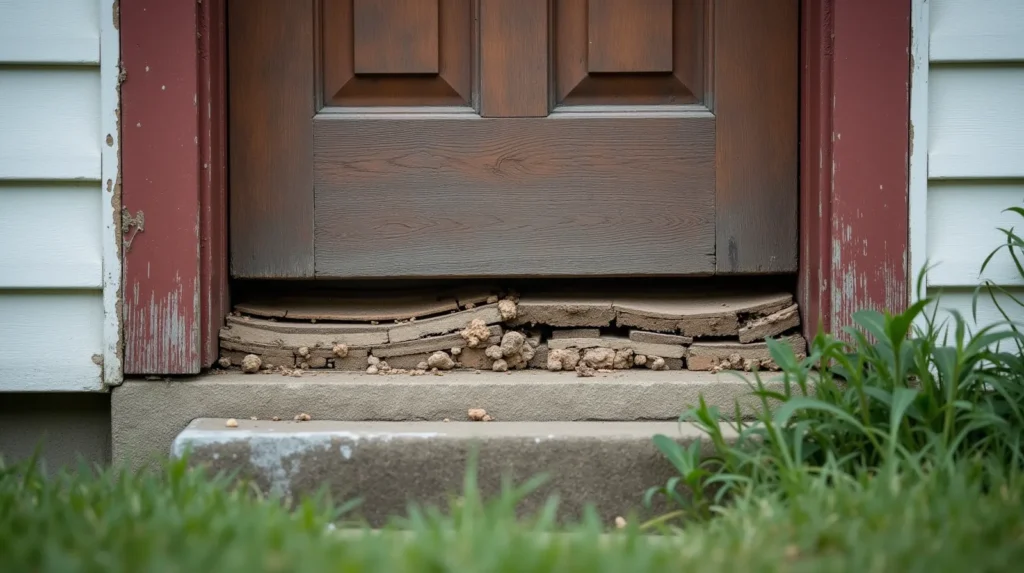
The inspection report came back with the wood-destroying organism section checked. Now you’re trying to figure out what that means for the sale.
The short version: You can sell a house with active termites or prior termite damage without treating it first. FHA and VA financing will not close on active infestations, so your buyer pool shrinks to cash buyers and conventional-loan buyers willing to accept the risk. We buy termite-damaged houses as-is — offer within 24 hours, no fumigation required, no structural repairs before closing.
Why termites block most financed sales
FHA and VA loans cover a large share of first-time buyer financing. Both require a wood-destroying organism (WDO) inspection in states with significant termite pressure — which includes Tennessee, Florida, and Texas. If active infestation is found, FHA guidelines (HUD Handbook 4000.1) require treatment and a clearance letter before the loan can close. VA follows the same requirement through its Lenders Handbook.
Conventional loans (Fannie Mae, Freddie Mac) do not automatically require WDO inspections — the lender decides. But an appraiser who observes visible termite damage is required to note it, and that note can trigger a lender condition requiring treatment before funding. The same FHA/VA financing block that applies to friable asbestos or active mold applies here — government-backed lenders do not close on known, unresolved structural health hazards.
The practical result: active termites eliminate FHA and VA buyers immediately, and may push conventional buyers away even when they are not required to walk. Your buyer pool, for a house with confirmed active infestation, is cash buyers and the rare conventional buyer who will make an offer subject to treatment.
What you’re required to disclose — by state
You cannot skip disclosure for what you know. Each state we work in has a specific rule.
Tennessee (TCA § 66-5-202)
Tennessee Code Annotated § 66-5-202 requires sellers to complete a Residential Property Condition Disclosure form before the sale. Item 20 asks directly whether the seller has knowledge of any wood-destroying insects or organisms, or any damage caused by them. If you know — from a prior inspection report, from visible damage, from a termite bond or treatment history — the answer is yes. Disclosure means stating what you know. It does not require you to fix it before listing.
Texas (Property Code § 5.008)
Texas Property Code § 5.008 requires a Seller’s Disclosure Notice on most residential transactions. Section 8 of the TREC-approved form (OP-H) asks two separate questions: whether the property has ever been treated for wood-destroying insects, and whether there is any current evidence of an infestation. If you had a Terminix bond in 2018 and treated again in 2023, both answers involve a yes. Both go on the form.
Florida (§ 689.261)
Florida does not use a single mandatory disclosure form, but § 689.261 requires sellers to disclose all known material defects that are not readily observable and that affect the property’s value or desirability. Termite damage inside walls, in the attic framing, or beneath subflooring qualifies. Drywood termites — the species requiring tent fumigation that are common in south Florida — are rarely visible during a casual walkthrough. If you know the damage is there, the disclosure obligation is triggered regardless of whether a buyer’s inspector would find it.
The disclosure obligation runs to what you know. It does not require a pre-listing inspection. But if you have prior inspection reports, those documents exist — a buyer’s attorney can subpoena them. Sellers who buried known termite history and closed have faced rescission claims and fraud actions years later. In Tennessee, the statute of limitations on a disclosure failure runs three years from the date of discovery.
What treatment and repair actually cost
This is where sellers frequently make the wrong calculation.
- Liquid barrier treatment (subterranean termites) — $300 to $900
- Borate wood treatment (preventive, limited penetration) — $500 to $1,500
- Tent fumigation (drywood termites, common in Florida) — $1,200 to $3,500 for an average house
- Structural wood repair after active damage — $2,000 to $30,000 or more, depending on location and severity
Treatment clears the living infestation. It does not repair what the termites already ate. If they worked through floor joists, wall framing, or subflooring over several years, a treatment certificate does not restore those members to load-bearing condition. Structural repair is a separate cost, and it is where the real money goes.
A seller with visible damage and an unknown history of spread faces a real calculation: spend $8,000 to $15,000 on treatment and structural repair, then list and wait 60 to 90 days — or accept less now and close in two weeks. Neither answer is obviously right. It depends on the extent of the damage and what the repaired house would actually sell for in your market.
Does homeowners insurance cover termite damage?
No. Standard HO-3 homeowners insurance explicitly excludes damage caused by insects, rodents, and other animals. Termite damage is not a covered peril — it does not matter who your carrier is or what your premium is.
A small number of specialty products offer termite riders, typically through pest control companies rather than insurers. They are rare, and they generally cap coverage well below the cost of real structural repair. If you have not specifically purchased a termite warranty or bond, assume there is no insurance path here. You are paying for treatment and repair entirely out of pocket.
This is a meaningful difference from water damage, where a sudden-loss insurance claim sometimes covers a portion of structural repair. With termites, the loss is gradual and excluded. The financial exposure is yours alone.
How a cash sale works when termites are present
We buy houses as-is, including properties with active infestations and known structural damage from termites. Here’s the process after you submit the address:
- We review the property and any inspection reports you have — within 24 hours
- We make a cash offer that reflects the condition, factoring in treatment cost and any visible structural repair needed
- You accept or walk away — no obligation either way
- We handle closing paperwork; you pick the date
- Close in 7 to 14 days — no fumigation required, no repairs, no agent commission
The offer will be below what the house would bring after the damage is repaired. That is an honest trade-off, not a hidden charge. The relevant question is whether the net — offer minus treatment cost, repair cost, carrying cost during the listing period, and the 5 to 6 percent agent commission you keep — favors the cash route. For some sellers it does, for others it does not. We will tell you which one honestly when we see the property.
In some cases we are not the direct buyer — we work with a network that includes other cash buyers and real estate companies. Either way, you receive a cash offer within 24 hours and there is no lender approval in the chain. The process applies whether the damage is in Nashville, Tampa, or Houston.
We’ve bought more than 100 houses and have seen termite damage range from a small section of subflooring to floor-to-ceiling framing damage in a 1950s Florida block house. The offer adjusts to what is actually there. If you have an inspection report, share it — it speeds the process and means we are not guessing at repair cost.
When you should not sell to us
If the damage is limited — a small area of subflooring, no compromise to structural members, and a straightforward liquid treatment will clear the infestation — repair and list with an agent may be the better call. In an active market, a clean WDO clearance letter plus a documented repair can get you close to full market value. The math works when total treatment-plus-repair cost is under 4 percent of the home’s value and you have 60 or more days.
A cash buyer’s offer accounts for worst-case repair cost because we are absorbing the risk of finding something worse than the inspection showed. If the real repair cost is well below what we are pricing in, that spread goes to us, not you. When the damage is genuinely minor and contained, a conventional sale after repair nets you more money. We will tell you so rather than make an offer that does not make sense for you.
We are the right fit when: the structural damage is uncertain or extensive, the house has other condition issues we would also need to factor in, the timeline is short (an estate settlement, a relocation, a financial deadline), or the cost of treatment plus repair plus carrying costs while listed is approaching or exceeding the discount in our offer. Learn more about how selling as-is for cash works across different property conditions.
Straight answers
Can I sell a house with active termites?
Yes. Active infestation is not a legal bar to selling. It is a practical bar to FHA and VA financing, and it reduces your buyer pool to cash buyers and conventional-loan buyers willing to take on the risk. You must disclose what you know under TCA § 66-5-202 (TN), Texas Property Code § 5.008 (TX), or Florida’s material defect standard (FL).
Do I have to pay for fumigation before selling?
No — not if you are selling to a cash buyer who accepts the property as-is. You would be required to treat if the contract makes it a condition, which FHA and VA buyers typically require, or if you negotiate it as part of a conventional sale. A cash buyer closes on the property in its current condition, infestation included.
Do I have to disclose termites when selling my house?
Yes, if you know about them. Tennessee, Texas, and Florida all require disclosure of known termite history, active infestation, or prior treatment. Selling as-is does not exempt you from disclosure. An “as-is” contract means the buyer accepts the physical condition — not that you withheld what you knew.
Does homeowners insurance cover termite damage?
No. Standard homeowners insurance excludes pest damage under the insects and animals exclusion. Termite damage is not a covered peril on any standard HO-3 policy. You are paying for treatment and structural repair entirely out of pocket.
How much does termite damage reduce a home’s value?
Active, untreated infestation with structural damage typically reduces value by 10 to 25 percent compared to a comparable repaired house, depending on the severity. Treatment history with complete structural repairs and a current clear inspection carries minimal stigma in most markets. The real variable is whether the structural damage was actually addressed — or just the insects.
Can I sell a house in Florida with drywood termites without tenting?
Yes — to a cash buyer. Drywood termite infestation in Florida typically makes a conventional sale contingent on tent fumigation because FHA/VA require it and financed buyers request it. A cash buyer who accepts the property as-is does not require fumigation as a precondition. Florida’s subterranean, drywood, and Formosan populations are among the highest in the country — for context on selling in that market, see our Florida buyer guide.
How long does a cash sale take on a termite-damaged house?
Seven to 14 days from accepted offer to close, in most cases. You pick the closing date within that window. No fumigation period, no repair phase, no lender appraisal timeline.
Keep reading
- Selling a House with Water Damage
- Sell My House Fast Madison, AL
- Sell a Vacant House: The Costs That Stack Every Month
- Sell My House Fast in Waukesha, WI — Cash Offer in 24 Hours
- Selling a House to Pay for Assisted Living
- Selling a House with Sewer Line Problems
Ready for a number? Get your cash offer or call (615) 780-7349.