


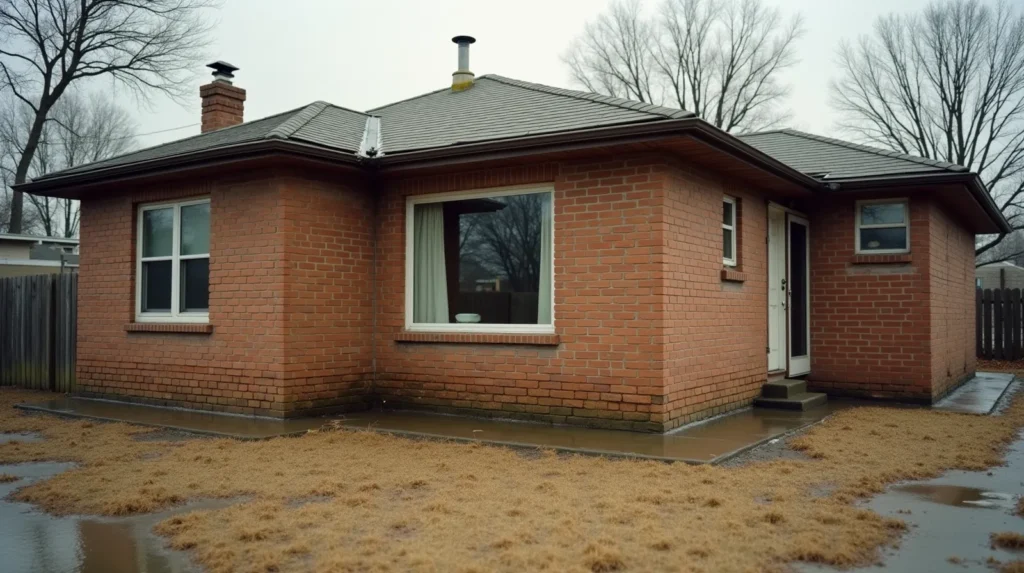
What water damage actually does to your buyer pool
Most buyers need a loan. Lenders need an appraisal. Appraisers flag active water intrusion, visible moisture damage, or signs of structural compromise — and when they do, the loan dies before it closes.
That’s the mechanism. It doesn’t matter how long you’ve owned the house or how much equity you have. A water-damaged home without clean remediation documentation is, for practical purposes, a cash-only sale.
The question isn’t whether you can sell. You can. The question is what buyer pool you’re selling into and what that does to your number.
The short version: You can sell a water-damaged house as-is, but conventional buyers are mostly out. Your realistic pool is investors and cash buyers. You’ll take a discount — typically 20–50% below fully repaired market value depending on severity. That may still net you more than repairing, waiting, and selling through an agent once you factor in remediation costs, contractor timelines, and carrying costs.
If the damage is minor, documented, and fully repaired with a clearance report, a traditional sale is still possible. Read on to find out which category you’re in.
What Tennessee and federal law require you to disclose
In Tennessee, T.C.A. § 66-5-202 requires sellers to disclose all known material defects on the Residential Property Disclosure Form before a contract is signed. Water intrusion — past or present — is a material defect. So is flood damage, drainage problems, and foundation issues related to moisture.
This applies even if the damage is repaired. “I fixed it” doesn’t erase the disclosure obligation. The form has specific checkboxes for flooding, water intrusion, and drainage defects. Checking “no” when there’s a history is misrepresentation, which opens you to rescission of sale, damages, and potential fraud claims under T.C.A. § 66-5-208.
In Florida, § 689.261 Fla. Stat. (effective July 1, 2023) adds a separate layer: sellers must disclose in writing whether the property is located in a Special Flood Hazard Area (SFHA) and whether they’ve made any insurance claims for flood or wind damage in the prior five years.
The practical takeaway: disclose everything you know. Hiding water damage does not help you sell faster. It creates legal exposure that follows you after closing.
The insurance money question sellers most often get wrong
If you have a mortgage, the insurance check is typically made jointly to you and your lender. Your lender is a lienholder and they have the right to require those funds be used for repairs — or held in escrow — before releasing them to you. You do not automatically get to pocket the payout and sell as-is without involving your lender.
If you own the house free and clear, the insurance payout is yours. You can choose not to repair, and sell the house as-is in its current condition. The buyer pays a reduced price that reflects the unrepaired state. You walk away with the payout plus the sale proceeds minus the damage discount.
A few things that complicate this:
National Flood Insurance Program (NFIP) payouts: FEMA’s NFIP pays based on Actual Cash Value (ACV) — replacement cost minus depreciation — unless you specifically bought Replacement Cost Value coverage. The average NFIP claim settlement runs roughly $40,000–$50,000. Full remediation on a mid-size home with structural damage commonly runs $60,000–$150,000 or more. The gap is real.
FEMA’s Substantial Damage rule: If your local floodplain administrator determines that the cost to restore the building equals or exceeds 50 percent of its pre-damage market value, the structure is legally “substantially damaged.” Before it can receive a certificate of occupancy, it must be brought into compliance with current floodplain management requirements. For homes in FEMA AE or AO zones, that typically means elevation — which costs $50,000–$150,000 on its own. At that point, most sellers cannot afford to bring the property to code and cannot sell it conventionally. A cash buyer who understands flood zone regulations becomes the only realistic path.
What remediation actually costs — and when the math stops working
| Damage type | Typical cost range |
|---|---|
| Water extraction and drying (water mitigation) | $3,000–$8,000 |
| Mold remediation (if present) | $5,000–$30,000+ |
| Drywall, insulation, subfloor replacement | $8,000–$40,000 |
| Structural framing repair | $15,000–$60,000+ |
| Foundation repair from sustained water infiltration | $8,000–$25,000+ |
| Elevation/code compliance after FEMA Substantial Damage | $50,000–$150,000+ |
Water damage almost always creates mold if remediation doesn’t begin within 24–72 hours — mold colonies can establish in that window, often inside wall cavities and subfloors where they’re invisible until drywall comes down. If you’re dealing with both, see our breakdown of selling a house with mold for what lenders require before they’ll close on a mold-affected property.
Water that reaches the foundation — through a flooded basement, sustained ground saturation, or hydrostatic pressure — frequently causes the cracking and settlement covered in our guide to selling a house with foundation problems. The two issues often arrive together.
Why FHA, VA, and USDA financing fails on water-damaged homes
HUD Handbook 4000.1 sets the standards FHA appraisers apply to every property. Active water intrusion, visible moisture damage to structural components, or evidence of drainage problems trigger an appraisal flag. The loan cannot close until the flagged conditions are repaired and re-inspected.
VA loans follow the same logic. The VA Lenders Handbook, Chapter 12, requires properties to be safe, sound, and sanitary. Active moisture damage fails that standard. A VA appraiser will condition the loan on repairs, and those repairs must be completed before closing.
USDA rural development loans carry comparable requirements.
What this means practically: if you haven’t repaired the damage and can’t produce remediation documentation, clearance reports, and a clean subsequent inspection, none of the government-backed loan programs will close on your house. You’re left with conventional buyers who can access portfolio lenders willing to look past condition — a small pool — or cash buyers. Selling as-is is the realistic path for most water-damaged properties that haven’t been fully remediated.
Tennessee flooding: what sellers here deal with that other states don’t
Tennessee’s foreclosure process is non-judicial. Under T.C.A. § 35-5-101, a lender can issue a 20-day cure notice and set a sale date 21 days out. The total window from first notice to auction can be under six weeks. For homeowners who missed payments during flood displacement — while dealing with FEMA paperwork, contractor bids, and temporary housing — that clock runs fast. If you’re in that situation, see how the foreclosure timeline works and how a cash sale fits inside it.
Nashville’s 2010 flood remains the benchmark for what water damage looks like at scale. The Cumberland River crested at 51.86 feet at the Nashville gauge in May 2010, damaging or destroying structures across Davidson, Williamson, and Cheatham counties. Homes along the Mill Creek and Cane Run Creek corridors in Antioch, Woodbine, and the Brentwood Road area carry FEMA AE zone designations that limit their buyer pool to this day — lenders require flood insurance, buyers run the numbers on $6,000–$10,000 annual flood premiums, and many walk away.
Waverly, Tennessee, in Humphreys County, saw 17 inches of rain in 24 hours in August 2021. Twenty people died. Hundreds of structures were destroyed or substantially damaged. Some of those properties are still unresolved because owners are caught between insurance disputes, FEMA Substantial Damage determinations, and the cost to elevate before they can receive a certificate of occupancy.
If you’re in a flood-prone corridor — Mill Creek, Harpeth River, Stones River, or any FEMA-mapped AE zone — and you’ve had water intrusion, the financing barrier for your next buyer is already built in. A cash buyer who knows the zone doesn’t need a lender’s approval.
Florida water damage: when the insurance-to-title pipeline stalls
Post-Ian and post-Milton, Florida’s property insurance market has partly stabilized but not uniformly. Citizens Insurance has been depopulating — moving policies to private carriers — and some of those carriers are declining or not renewing properties with recent claims or open water damage. A buyer who can’t get insured can’t get a mortgage.
FEMA’s Repetitive Loss program adds another layer. If a property has filed two or more NFIP flood claims totaling more than 25 percent of the structure’s value within a rolling 10-year window, it lands on the Repetitive Loss list. NFIP premiums on repetitive loss properties can run $10,000–$25,000 annually or more. At that price, almost no retail buyer can absorb the carrying cost, and almost no lender will extend a mortgage against that insurance burden.
In Pinellas, Charlotte, Lee, and Sarasota counties — where Hurricane Helene and Milton (October 2024) caused widespread inundation — properties with active open claims or unrepaired damage face a buyer pool that has narrowed to investors who can close without lender approval.
When you should not sell to us
We’re a cash buyer, not the right choice for every situation. A traditional sale will likely net you more if:
- The damage is minor — a single ceiling stain from a past roof leak, fully repaired with receipts and a clearance inspection. Retail buyers with conventional financing can still close on that.
- You have 60 or more days, equity to absorb remediation costs, and a contractor who can complete work and produce documentation. Repair, list, and sell to a financed buyer who pays full market value.
- Your insurance paid out enough to restore the property and you have clean documentation — a remediation company’s clearance report, before-and-after photos, and receipts. With proper documentation, some conventional lenders will close.
- A fresh inspection confirms no ongoing moisture, no mold, and no structural compromise from the water event.
If none of those describe your situation — if the damage is structural, the insurance payout fell short, you’re facing FEMA Substantial Damage elevation requirements, or you simply need to close and move on — that’s where a cash offer makes sense.
Straight answers
Can I sell a house with water damage as-is?
Yes. There’s no law that requires repairs before selling. The disclosure requirement is about honesty, not condition. What changes is your buyer pool — most financed buyers can’t close on a home with unrepaired water damage because their lender won’t fund it.
Does selling as-is mean I get a bad price?
It means you get a price that reflects the property’s current condition. A cash buyer prices based on what the house is worth after repair minus the cost and risk of those repairs. For houses facing $80,000 or more in repairs or FEMA elevation requirements, an as-is cash offer often nets more than the repair-and-list route once you account for carrying costs, contractor overruns, and the financing barrier that still exists in flood-zone markets.
Can I keep the NFIP payout and also sell as-is?
If you own the house free and clear, yes. If there’s a mortgage, your lender is a co-payee on the insurance check and will typically require the funds go toward repairs or be held in escrow. Do not deposit a joint-payee insurance check without talking to your lender first — doing so can breach your mortgage agreement.
Does water damage cause mold?
Almost always, if remediation doesn’t start within 24–72 hours. Mold can colonize inside wall cavities and subfloor framing without showing on visible surfaces. A house that sat unmitigated through a wet winter frequently has extensive mold by spring. See our detailed breakdown: selling a house with mold.
What if my roof damage caused the water intrusion?
Roof damage that allows water penetration is its own financing flag — separate from the interior water damage. See selling a house with roof damage for what appraisers look for and what lenders require before closing.
Here’s what happens after you give us the address
You give us the address and a description of what happened. We review the property, the flood zone status, and whatever documentation you have. We make a cash offer within 24 hours — no obligation, no pressure to accept.
We buy as-is. No repairs before closing, no cleanup, no staging. You pick the closing date — 7 to 14 days is typical, or longer if you need more time. No commission, no fees. We buy directly or bring a buyer from our network who will.
Call (615) 780-7349 or put your address in the form above. We’ll tell you what the house is worth to us and what the timeline looks like.
Keep reading
- Sell My House Fast Converse TX
- Can I Sell My House With a Lien on It?
- Sell My House Fast Indianapolis IN — Cash Offer in 24 Hours
- Sell My House Fast in Milwaukee, WI
- Sell My House Fast in Atlanta, GA — Cash Offer in 24 Hours
- Selling a House With a Pest Infestation
Ready for a number? Get your cash offer or call (615) 780-7349.