


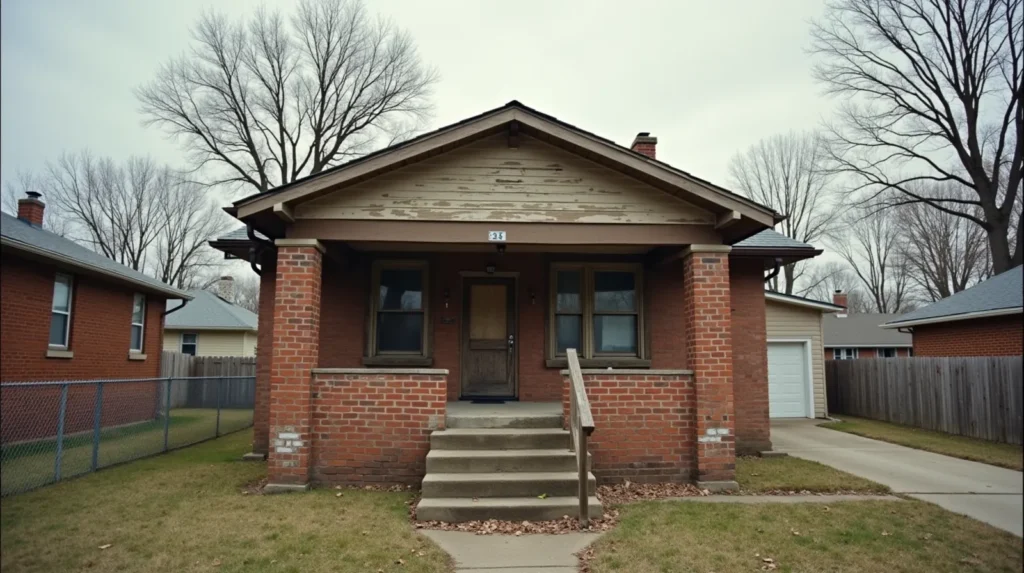
What the code violation notice actually means for your sale
You got a notice from the city. Or the buyer’s inspector flagged something and now the lender won’t fund. Either way, the question is the same: does this kill the sale?
It does not kill the sale — but it does eliminate a large portion of your potential buyers, and it requires disclosure. Here is what actually happens.
Short answer: You can sell with open code violations. The real problem is that FHA and VA buyers — and many conventional buyers — cannot get a loan approved until violations are resolved. That shrinks your buyer pool to cash buyers and investors. If you have 7–14 days, we buy houses as-is, violations included, and we handle the lien situation at closing. If you have 60 or more days and the violations are minor, an agent and a quick repair may net you more.
What code violations actually block at closing
A code violation notice from the city is a separate problem from an inspector’s finding — but both can stop a financed sale.
Financed buyers: FHA appraisers are required under HUD Handbook 4000.1 to flag any condition that poses a health or safety risk, including open code enforcement citations. When an FHA appraiser flags a violation, the lender issues a repair condition — the loan will not fund until the condition is signed off. VA appraisers follow similar requirements under the VA Lenders Handbook Chapter 12 (safe, sound, and sanitary). Most conventional lenders follow the same principle, though the threshold is slightly higher for minor cosmetic issues.
The result: a buyer who arrives with an FHA or VA pre-approval cannot close on your property while the violation is open. That eliminates roughly 30–40% of the active buyer pool in most Tennessee markets, and a higher share in military-heavy areas like Fort Campbell and Clarksville.
Cash buyers have no lender appraisal requirement. They can close with violations in place, with the lien resolution handled through the closing statement. See how this connects to selling a house with a lien already on title — the mechanics at closing are the same.
The lien problem in Tennessee: if a Metro Codes Notice of Violation escalates to a lien filing, that lien attaches to the title under T.C.A. § 13-21-109. The lien must be satisfied before clear title passes. In practice, the lien balance — accumulated fines plus administrative fees — is paid out of the seller’s proceeds at closing through the title company. A cash buyer can accommodate this; a buyer’s lender generally will not proceed until the lien is released first.
What Tennessee disclosure law requires you to say
Tennessee is one of the stronger disclosure states. T.C.A. § 66-5-202 requires sellers to disclose known material defects — and an open code violation that affects the property’s safety, habitability, or market value qualifies as a material defect.
The disclosure requirement does not go away in an as-is sale. T.C.A. § 66-5-208 makes this explicit: an as-is clause does not relieve a seller of the obligation to disclose known material defects. The TREC Residential Property Disclosure form has a specific question asking about code violations and pending government actions. You answer yes.
What this means practically: you disclose the violation, and the buyer decides whether to proceed. The as-is clause then protects you from post-closing claims that the buyer didn’t know about the condition. This is the same disclosure framework that applies when selling a house with unpermitted work — the distinction is that code violations come from an active city or county citation, while unpermitted work is construction done without a permit, which may or may not be cited.
Failing to disclose a known violation creates liability. A buyer who discovers an undisclosed code violation after closing has a claim under both the disclosure statute and common law fraud. The as-is contract does not protect you from that.
How Nashville Metro Codes enforcement actually works
Nashville-Davidson County Metro Codes Enforcement follows a standard escalation path. A complaint — from a neighbor, a city inspector, or a buyer’s inspector report — triggers an inspection. If a violation is found, the department issues a Notice of Violation with a compliance deadline, typically 30 to 90 days depending on the type of violation.
If the violation is not corrected by the deadline:
- Metro Codes issues a Compliance Order
- The case may be referred to Environmental Court (Davidson County General Sessions)
- Daily fines begin accruing — typically $50 to $500 per day depending on severity
- If fines accumulate and remain unpaid, Metro Codes can file a lien against the property title
The lien filing is what creates the title problem. Before that stage, a code violation is a notice — you still have time to correct it or sell to someone who will. After the lien attaches, it must be resolved at closing regardless of who the buyer is.
For sellers in Shelby County, Knox County, and Hamilton County, enforcement operates under similar frameworks through those counties’ code departments, but timelines and fine structures vary. Sellers in rural, unincorporated areas of Tennessee should check with their specific county — many Tennessee counties have not adopted countywide residential building codes, so code enforcement in those areas varies significantly by jurisdiction.
How Florida code enforcement liens work — and how they’re negotiated
Florida’s code enforcement system operates under F.S. § 162.09 (code enforcement board authority) and § 162.10 (fine accrual). When a code enforcement board finds a violation, it sets a compliance deadline and a daily fine — commonly $250 to $500 per day for residential violations. If the deadline passes, fines begin accruing automatically.
The fines are recorded in the Official Records of the county as a lien under F.S. § 162.10. Once recorded, the lien must be satisfied before the property can convey clear title. However — and this is the detail most sellers miss — Florida counties routinely negotiate accumulated code enforcement liens down to a fraction of the total. The range in practice is 5% to 15% of the total accumulated fine, particularly when the underlying violation has been corrected or when the buyer presents a plan to remedy it.
For a house in Broward County with $80,000 in accumulated fines, a lien negotiation to $4,000–$12,000 is realistic. The negotiation is handled through the county code enforcement board, not through the title company — and the timeline for board approval is typically 30 to 60 days. This is why selling to a cash buyer who can wait for lien resolution, rather than a financed buyer whose lender won’t proceed until the lien is released, is often the practical path in Florida.
Three paths for selling a house with code violations
Path 1: Fix the violations before listing. This makes sense when the violations are minor, the cost of correction is less than the discount a buyer will demand, and you have 60 or more days. An electrician who adds missing GFCI outlets and addresses a panel condition costs far less than the negotiated price reduction a buyer will demand at inspection. A contractor who installs a missing pool barrier costs less than selling at investor pricing. This path fails when the violations are structural, the repair cost is significant relative to your equity, or you don’t have time or cash for repairs before listing.
Path 2: Disclose, price it in, and offer a repair credit. You list as-is, disclose all violations on the TREC form, price accordingly, and offer the buyer a repair credit at closing. This works for buyers who can get conventional financing — not FHA or VA, which require the condition resolved before funding — and are willing to take on the repair themselves. The challenge: fewer buyers qualify, and the negotiation is harder than it sounds. Also see how to sell a house as-is for the full mechanics of this approach.
Path 3: Sell to a cash buyer. No lender appraisal, no repair conditions, no FHA/VA restrictions. The violations are disclosed, the lien situation is factored into the offer, and the lien balance comes out of proceeds at closing through the title company. Cash buyers who operate in Tennessee and Florida handle Metro Codes enforcement actions, county lien situations, and inspector-flagged conditions regularly — these are not exotic problems for buyers who don’t need a lender’s approval to close.
You get a cash offer within 24 hours of giving us the address. Closing in 7 to 14 days. No agent commission — that’s 5–6% you keep — no closing cost surprises, no repairs.
When you should not sell to us
If the violations are cosmetic — a missing handrail, a broken fence, a non-functioning smoke detector — and you have 60 or more days, correcting them and listing with an agent will likely net you more money than a cash offer.
A cash buyer prices in the risk: the carrying cost during lien resolution, the uncertainty of final repair costs, the discount for buying without conventional buyers competing. If those risks are small and your timeline allows, they belong in your pocket, not ours.
The situations where a cash sale is clearly the better path:
- The violations are structural or expensive to remediate
- A code enforcement lien has already attached to title
- You cannot fund repairs before listing
- Your timeline is 30 days or less
- The property has accumulated fines requiring county negotiation, adding 60+ days to a conventional sale
- You have other encumbrances alongside the code violations — an IRS lien, a condemnation order, or a foreclosure notice
Straight answers
Can I sell a house with an active code enforcement lien in Tennessee?
Yes. The lien is paid from your proceeds at closing through the title company. You do not have to resolve it before listing or before signing a contract — it resolves at the time of closing when the title company pays the lien balance as part of the disbursement.
Does a code violation automatically put my house in foreclosure?
No. In Tennessee, a code enforcement lien is separate from a mortgage foreclosure. The city can pursue collection of an unpaid code enforcement lien through its own process — Environmental Court in Davidson County — but that does not accelerate your mortgage. It is a separate claim on the property. If your mortgage lender discovers a code enforcement lien through a title search during a refinance or sale, they will require it resolved before closing any transaction.
What code violations stop FHA and VA buyers from closing?
The violations that FHA appraisers flag most consistently: missing or non-functioning GFCI outlets in kitchens, bathrooms, and garages; exposed wiring or a panel in condemned condition; a roof that doesn’t meet the two-year remaining life requirement under HUD 4000.1 Section II.B.3.j; structural conditions including foundation movement or compromised load-bearing elements; missing pool barriers required by local ordinance; and active water intrusion with evidence of mold. Any of these generates a repair condition from an FHA lender. See also the full breakdown in selling a house with foundation problems for how lenders treat structural issues specifically.
Will the city find out I’m selling?
Selling the property does not trigger automatic notification to the code enforcement department. However, if a violation is already in the enforcement system, the city’s records remain regardless of ownership. A buyer’s attorney pulling code enforcement history will find it. Disclosing it on the TREC form is both legally required and the only defensible position.
Can my buyer take over the code violation case?
Yes — the code violation case follows the property, not the seller. Once you transfer title, the new owner becomes responsible for bringing the property into compliance. Cash buyers and investors frequently purchase properties this way: they buy, remedy the violation themselves after closing, and resolve the city’s case as the new owner. This is why a cash buyer can close on a property that a financed buyer cannot.
One action
Give us the address. We’ll have a cash offer within 24 hours — no obligation, no pressure. We buy houses as-is with open code violations, handle the lien situation at closing, and can close in 7 to 14 days. If the numbers don’t work for you, you’ve lost nothing. Call (615) 780-7349 or submit the address in the form on this page.
Keep reading
- How to Sell a Mobile Home Fast for Cash
- Sell My House Fast Huntsville, AL
- We Buy Houses Indiana — Cash Offer in 24 Hours
- Sell My House Fast in Omaha, NE
- How to Sell a House With Solar Panels
- Selling a Tennessee Property With an Unauthorized Occupant
Ready for a number? Get your cash offer or call (615) 780-7349.