


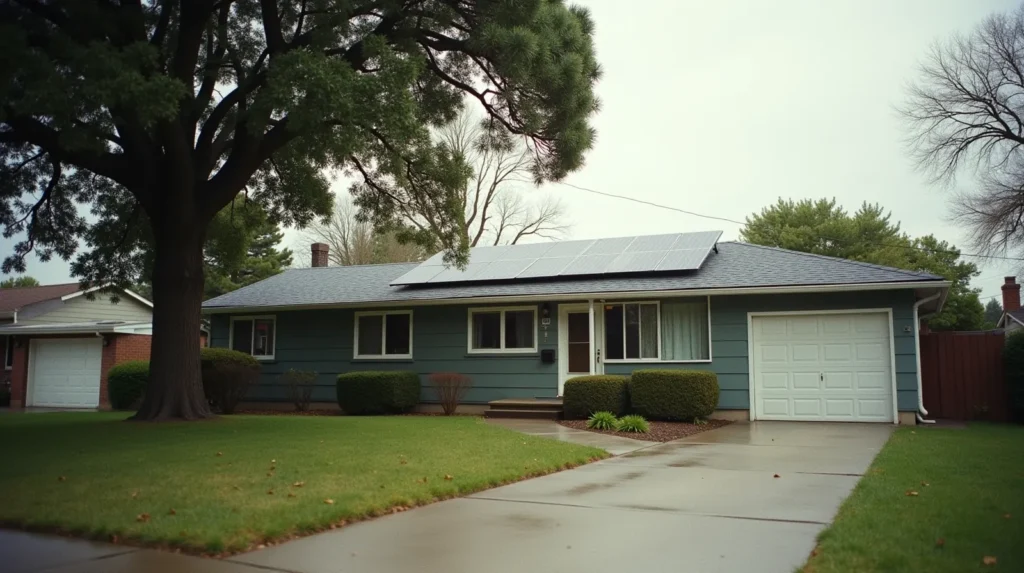
The question isn’t whether panels add value — it’s who owns them
If you own the panels free and clear, solar is a selling point. A lower utility bill is easy to market and your agent knows what to do with it.
If you’re leasing the panels, or still paying off a solar loan, or the deal fell apart because the buyer couldn’t qualify to assume the lease — that’s what this page is about.
Here’s what actually happens across the three ownership scenarios, and when a cash offer makes more sense than waiting for the next conventional buyer to clear the solar company’s approval process.
TL;DR
Leased panels belong to the solar company, not you. The buyer has to qualify to take over the contract — and many don’t. A solar loan files a UCC-1 lien against the panels that shows up on title and has to be cleared before any close. If either is blocking your sale, a cash buyer handles the transaction differently: no bank underwriter, no appraisal, and we work around the payoff or lease transfer on your timeline. Cash offer within 24 hours. Close in 7–14 days. No fees, no commission.
Three ownership types, three different problems
| Ownership type | Who owns the panels | What you deal with at closing | Complication level |
|---|---|---|---|
| Paid off / cash purchase | You | Transfer warranty, hand over documentation | Low — standard sale |
| Solar loan (financed) | You (subject to lien) | UCC-1 lien must be paid off or discharged at closing | Medium — depends on your equity |
| Lease or PPA | Solar company | Buyer must pass the solar company’s credit check | High — approval not guaranteed |
Owned outright. You paid cash for the system or paid off the loan. The panels are yours. When you sell, you transfer the warranty, hand over documentation, and market the lower electric bill. No extra steps beyond a conventional sale.
Solar loan or financed system. The installer or a third-party lender filed a UCC-1 financing statement — a lien against the panels as personal property. That filing appears on a title search. Before closing, you either pay off the balance from your sale proceeds or coordinate a transfer with the lender. Balances vary widely depending on system size and how much you’ve paid down. If the payoff exceeds your equity, you come up short at the closing table.
Leased system or PPA. A solar company owns the panels. You signed a 20–25 year contract to buy the electricity they produce, typically at a rate slightly below grid price. That contract runs with the property — the buyer has to take it over, or you buy out the lease before closing. Buyout costs vary significantly by company, remaining term, and contract terms; for a lease eight to twelve years in, they are rarely small. Contact the solar company early for the buyout figure — it’s different from the monthly payment and it isn’t always disclosed upfront.
Why lease transfers keep falling through
To transfer a solar lease, the solar company has to approve the buyer’s credit. That approval is a separate process from the mortgage — and it often runs late.
A buyer can pre-qualify for $400,000 from their lender and still be denied by Sunrun or Sunnova. When the denial comes at day 40 of a 45-day escrow, the deal is finished.
Some solar companies take 30 to 60 days to complete a transfer review. The mortgage lender’s underwriting clock does not stop while that review is pending. Deals that were days from closing have fallen apart over this single step.
This is the scenario where a cash offer becomes the practical path out.
What changes when the buyer pays cash
A cash buyer does not go through mortgage underwriting. No bank appraiser, no lender checklist, no underwriting contingency tied to title being clean of the UCC-1.
On the solar situation specifically: we still need to handle it. We’ll either assume the contract, coordinate a transfer, or negotiate a lease buyout and fold it into the transaction. What we remove is the mortgage-financing layer — the step where a conventional buyer’s lender refuses to close because of an open UCC-1 or a denied lease transfer.
You’ll have a cash offer within 24 hours of submitting your address. The close typically takes 7 to 14 days once paperwork is in order — solar documentation occasionally adds a few days depending on the company. You pick the date.
No agent commission (that’s 5–6% you keep). No repairs. No fees. We buy directly, and where we’re not the right buyer, we’ll bring one who is.
If your situation involves a property you need to sell as-is alongside the solar complications, the process is the same — one offer, one close, no repair list.
State details: TN, TX, and FL
Tennessee. Most of the state is served by TVA, which has a net metering program for grid-tied solar. When you sell, the net metering agreement typically transfers with the property, but both parties should confirm this with TVA or the local power company before closing. Tennessee’s seller disclosure statute (TCA § 66-5-202) covers material defects and encumbrances; a leased solar system that limits what the buyer can modify is worth disclosing clearly regardless of whether it’s technically required under that statute. Nashville and the surrounding counties have seen significant solar installations from Sunrun and other national installers since 2020.
Texas. TREC’s Seller’s Disclosure Notice (Form OP-H, Section 5) requires you to disclose whether the property has a solar panel system and whether it’s owned or leased. This is mandatory. The UCC-1 filing issue is common in Texas because several large solar installers have deep roots here, and the filing shows up at the county clerk level on any preliminary title report. Buyers’ lenders flag it and ask for subordination or payoff before funding. If you’re already dealing with a lien that’s complicating a sale, the solar UCC-1 follows the same payoff-at-closing process as any other lien on title.
Florida. Florida has one of the highest residential solar adoption rates in the country, and it has large lease portfolios from Vivint (now NRG Home), Sunrun, and FPL SolarNow. Florida’s 2023 net billing rule changes reduced the export credit rate for new solar customers; buyers assuming an older lease may actually be taking on a contract with better economics than they could get today — a genuine selling point if the rate is locked in. One additional wrinkle: Citizens Insurance evaluates roof condition separately, and a solar installation that has affected the roof decking introduces another variable for buyers who need homeowners insurance. If your Florida property has a solar lease and a complicated insurance situation, a cash close may be the only clean path to a close. We buy houses throughout Florida and have seen this combination before.
When you should not sell to us
If you own the panels outright and the system is working, list with an agent. You’ll get more money. Research from Lawrence Berkeley National Laboratory consistently shows that owned solar systems add measurable value to a home’s sale price, and agents know how to document it for an appraisal. A cash offer from us will be below what the market would pay — that tradeoff only makes sense when a conventional sale has a problem it can’t solve on its own.
If your solar loan balance is small relative to your equity and you have 60 or more days before any deadline, a conventional sale will likely net you more even after paying off the loan at closing.
The situations where a cash offer makes more sense than waiting:
- A lease transfer already failed with a previous buyer
- You need to close in under 30 days and the solar company’s review will take longer
- The solar loan balance exceeds what you’d net from a conventional sale after commission and repairs
- You’re managing another complication — a foreclosure deadline, an estate, a divorce — and the solar situation is one more layer the conventional buyer’s lender won’t touch
Straight answers
Does a solar lease transfer automatically when I sell?
No. The buyer has to apply and be approved by the solar company. The transfer is not automatic and typically takes 30–60 days from application to completion — during which your escrow clock is still running.
Can a solar UCC-1 lien block my closing?
Not on its own, but lenders require it to be subordinated or discharged before they’ll fund a mortgage. If the solar lender won’t cooperate quickly, the financed buyer can’t close. Cash buyers don’t have a lender in that position.
Can I pay off the solar loan at closing like a second mortgage?
Yes, if you have the equity. The payoff comes from your sale proceeds at closing, same as any lien. Get the payoff statement early — some solar lenders are slow to produce it, and the balance changes as interest accrues daily.
What if the lease buyout is more than I can afford from sale proceeds?
Options are: transfer the lease to a buyer who qualifies, negotiate a reduced buyout with the solar company, or price the house to reflect the buyer assuming the lease contract. A buyer who takes the lease gets the benefit of the locked rate; that has real value and can be part of the negotiation.
Do solar panels add value in Tennessee?
For owned systems, studies consistently show a premium in most markets nationally. Tennessee data is thinner because adoption is more recent here. A cash buyer will not pay extra for the projected energy output — we’re buying the real estate. The panel value is relevant in a conventional appraisal with a buyer who plans to use the system long-term.