


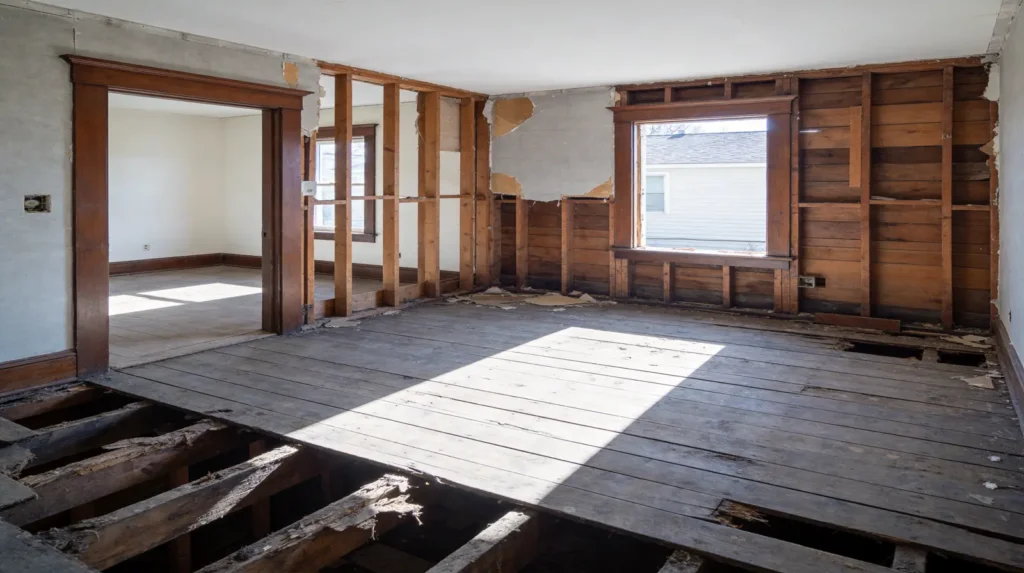
What you’re actually dealing with
Some houses need a few repairs. Others need to go down to the studs — new electrical, new plumbing, joists sister-framed, roof decking replaced, every room stripped. If you have one of those, a standard MLS listing is not going to work the way you’d hope.
Most buyers need a mortgage. Most lenders will not fund a house in total-renovation condition. The ones who might need a renovation loan with a contractor, a permit plan, and four to six months of construction management. Most sellers in your situation don’t have that kind of time or bandwidth.
This page is for sellers with a gut-renovation property who want to understand what their realistic options actually are.
A house needing complete renovation — structural work, full electrical, plumbing overhaul, new everything — has one realistic buyer: a cash investor who prices from ARV. Their offer will be roughly (ARV × 70%) minus estimated repair costs. That is lower than a renovated sale price. For some sellers, it’s the only number on the table. Below is the math and when a cash sale makes sense versus not.
Why most financed buyers can’t close on a gut-renovation property
Conventional lenders and government-backed programs require the property to meet minimum property standards before they’ll fund. A gut-renovation house typically fails those standards in several places at once.
FHA’s Minimum Property Requirements under HUD 4000.1 flag: non-functioning utilities, exposed electrical wiring, structural damage, inadequate roofing, and active water intrusion. A house that needs total renovation commonly fails multiple categories simultaneously. The appraiser writes conditions. The lender won’t fund until those conditions are resolved. The buyer walks.
There is a loan designed for this situation: the FHA 203(k) Standard loan, which bundles the purchase price and renovation costs into one mortgage. Here is why it rarely resolves the problem on a true gut renovation:
- Licensed contractor with a work order and permit plan required before closing
- HUD consultant reviews the scope, approves each draw, and inspects every construction phase
- 3–6 months from accepted offer to construction completion, minimum
- Lender adds 10–20% contingency reserve on top of the renovation estimate
- Contractor availability for 203(k) projects — with draw schedules and HUD inspections — is limited in most markets
A buyer can execute a 203(k) on a house with one failing system. On a house needing everything replaced, most don’t make it to the closing table. Fannie Mae’s HomeStyle renovation loan works the same way. Both products are legitimate. Neither reliably closes on a complete gut rehab.
How a cash buyer prices a gut-renovation property
Cash investors — who buy as-is and renovate for resale or rental — price from the ARV: the after-repair value, meaning what the house would sell for when the renovation is done.
The common starting formula is the 70% rule:
Cash offer = (ARV × 70%) − estimated repairs
Example: a pre-war frame house in East Nashville where renovated comparables are selling at $310,000. The investor’s contractor estimates $90,000 in work — new electrical, plumbing, drywall, kitchen, flooring, roof, and HVAC.
(310,000 × 0.70) − 90,000 = $217,000 − $90,000 = $127,000
The offer lands in that range, adjusted for the investor’s specific margin requirement and holding cost estimate.
That number feels low against the $310,000 ARV. Before deciding that, run the real math on the other path:
| Path | Gross sale | Costs | Estimated net |
|---|---|---|---|
| Renovate and list with agent | $310,000 | $90k repairs + $18.6k commission (6%) + $8k–$12k carrying + closing costs | ~$185k–$193k |
| Cash offer as-is | $127,000 | $0 repairs, $0 commission, $0 closing costs (buyer pays) | ~$127k |
The gap is roughly $58k–$66k. Whether that gap is worth six months of renovation coordination, contractor management, and inspection risk depends entirely on your situation. For a seller who is out of state, on a deadline, or cannot fund the renovation upfront, it often isn’t.
Give us the address. We’ll give you a number based on your actual property within 24 hours.
When a cash sale is not the right answer
If the renovation is cosmetic — paint, flooring, fixtures, landscaping — a financed buyer can close on the house. Your net from a standard listing will almost always be higher than a cash offer. Sell through an agent.
If the house needs one fixable system, not everything, and a contractor can complete the work in four to six weeks, repairing first usually nets more. The cash buyer’s 30% margin is there to cover renovation risk. If the risk is small, the discount is unjustified.
If you have 90 or more days and the market is moving in your area, an agent listing — even with a significant price reduction for condition — often produces a better number than a direct cash sale on properties in moderate disrepair.
We will tell you plainly if an agent listing makes more sense for your house. We do not need every deal to close. The sellers who fit this path know it before they call us — the house needs too much work, they don’t have the time or money to do it, and they need out.
Tennessee
Under TCA § 66-5-202, sellers must disclose known material defects — including on cash sales. On a gut-renovation property, the condition is usually self-evident and both parties know it going in. We do not require repairs as a condition of the offer.
The pre-1940 housing stock in East Nashville — Lockeland Springs, Eastwood, Greenwood, Edgefield — and in Germantown, Waverly-Belmont, and Sylvan Park contains the largest concentration of gut-renovation candidates in the Nashville market. These are balloon-framed brick and frame structures with plaster walls, original knob-and-tube or early aluminum wiring, galvanized supply lines, and in many cases failing masonry chimneys. The renovation scope is rarely one system.
Robertson, Cheatham, and Dickson counties see a different pattern: rural farmhouses from the 1940s through 1970s that have been passed down through families and not updated in decades. Estate situations where heirs live out of state and cannot coordinate a renovation are common. A cash close is often the only practical exit.
If the property enters foreclosure, TCA § 35-5-101 et seq. runs a 60–90 day timeline from breach notice to Davidson County Courthouse auction. A cash close in 7–14 days stops that clock before the auction date is set.
Texas
Texas disclosure obligations appear on TREC Form OP-H (§ 5.008). For gut-renovation properties where the full scope of problems isn’t known — because walls haven’t been opened — “unknown” is a legally permissible answer on items you genuinely cannot assess. Full disclosure of known conditions is required.
The 1950s–1960s inner-ring stock in Houston (Montrose, the Heights, Garden Oaks), Dallas (Oak Cliff, M Streets, Lakewood), and Austin (Hyde Park, Bouldin Creek) holds a significant share of total-renovation inventory. These houses appreciated sharply during 2020–2022. Many were not renovated during that window. They are now priced against renovated comparables but in condition that blocks financed buyers.
Texas non-judicial foreclosure under Property Code § 51.002 runs 41 days from acceleration notice to first-Tuesday auction with no right of redemption after the trustee’s deed records. Conventional financing cannot close inside that window reliably. A cash close can.
Florida
Florida’s post-hurricane insurance market has added a layer of complexity to gut-renovation sales in coastal counties. A house needing total renovation in Hillsborough, Pinellas, Lee, or Charlotte County may also fail Citizens Insurance’s current underwriting requirements — which require functional roofing, electrical, and HVAC. No insurance means no mortgage, independent of the renovation scope.
Post-Ian (2022), post-Helene and post-Milton (2024) damage compounds the situation on older Lee County and Charlotte County stock. Some of these properties have simultaneous insurance claims, open permit holds, and total-renovation scope. A cash buyer closes on all of it.
For older condominium projects, Florida SB 154 (2023) imposed mandatory structural milestone inspections and reserve funding requirements for buildings three stories or taller built before 1992. Units in non-compliant projects have lost FHA and VA warrantability, leaving cash investors as the primary exit. Florida disclosure obligations under FL § 689.261 apply to cash sales.
Minnesota
The pre-1950 Craftsman and Tudor bungalow stock in north Minneapolis — Jordan, Willard-Hay, Folwell, Near North — and in Saint Paul’s Hamline-Midway, Frogtown, and Payne-Phalen neighborhoods contains a significant share of gut-renovation properties. These houses commonly need simultaneous replacement of knob-and-tube or early aluminum wiring, galvanized supply lines, original 100-amp panels, and failed or failing structural elements.
Minnesota winters add cost and timeline risk to any renovation. ISO HO-3 policies exclude freeze damage in unoccupied homes after 30–60 consecutive days. A gut-renovation property with deferred maintenance and missing or compromised insulation risks freeze damage over a single winter, compounding the scope. We buy houses in Minnesota and understand the inspection and disclosure timeline specific to Ramsey and Hennepin County properties.
Minn. Stat. § 513.55 requires sellers to provide a disclosure statement before a purchase agreement is signed. “Unknown” is a permissible answer for conditions that cannot reasonably be determined without opening walls.
Straight answers to common questions
Can I sell a house that needs total renovation without fixing anything?
Yes. A cash buyer purchases as-is. We do not require a single repair as a condition of the offer or closing.
How much less than market value will a cash buyer offer on a gut-renovation property?
Typically 60–75% of the after-repair value, minus estimated renovation costs. On a $300,000 ARV property needing $80,000 in work, the offer will be in the $100,000–$130,000 range. We show you the math behind the number.
Do I need to disclose all the problems even if I’m selling as-is?
Yes. TCA § 66-5-202 (TN), TREC Form OP-H (TX), and FL § 689.261 all require disclosure of known material defects regardless of sale format. A cash as-is sale does not eliminate disclosure obligations. It only means we are not requiring you to fix anything we find.
What happens if I can’t afford to fund the renovation but can’t get a cash offer high enough to pay off the mortgage?
This situation — where the as-is cash offer is less than the outstanding loan balance — is an underwater position. Give us the address and the payoff amount. There are options including short sale negotiation that we can walk you through. We have done this before.
Is the cash offer negotiable?
The number reflects a formula tied to real renovation costs and holding risk. It is not arbitrary. The components are transparent — if you have a contractor estimate that shows lower renovation costs than our estimate, that changes the number. We are not trying to lowball and hope you don’t notice.
The next step
If you have a house that needs everything and you need to understand what a cash offer looks like, give us the address. We will have a number back to you within 24 hours. No repairs, no inspections from our side, no obligation to accept.
We have bought more than 100 houses. A gut-renovation property is one we see regularly. We are not the right answer every time, but we will tell you plainly when we are not. Call (615) 780-7349 or enter the address below.
Related: selling a house in bad condition and how selling as-is actually works.
Keep reading
- Selling a House with a Damaged Roof
- Sell a Vacant House: The Costs That Stack Every Month
- Selling a House After Job Loss
- Selling a House with Termite Damage
- Can I Sell My House While It’s in Foreclosure?
- Selling a House With a Lien on It
Ready for a number? Get your cash offer or call (615) 780-7349.