


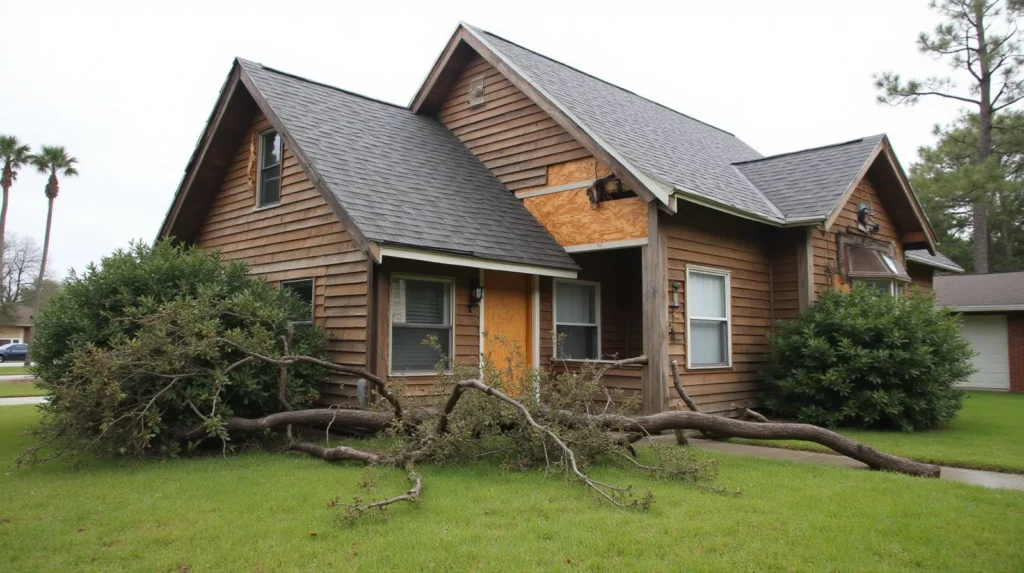
Your house took the hit. What happens to the sale?
A hurricane does not just damage a house — it damages your selling options. Roof blown off, water through the ceiling, structural cracks, a screened enclosure flat on the ground. The repairs are real. The insurance paperwork is a second job. And now you have to figure out whether you can sell.
The short answer is yes. A cash buyer does not need the house to pass an appraisal or a lender’s property standards checklist. The damage that kills a financed sale is exactly what a cash buyer prices in and moves forward on.
TL;DR
- Hurricane wind damage triggers FHA/VA repair conditions that block financed buyers until repairs are complete
- FL homeowners often carry two policies — Citizens (wind) and NFIP (flood) — and the claims are handled separately
- If you received an insurance payout and spent it without making repairs, you must disclose that in Florida, Texas, and Tennessee
- We buy houses with hurricane damage as-is — cash offer within 24 hours, you pick the closing date
- If your insurer is paying full replacement cost and you have 60–90 days, listing with an agent will net you more — read the caveat section before deciding
Why hurricane damage stops most buyers before they start
Most buyers need a mortgage. Mortgage lenders need an appraisal. FHA and VA appraisers work from HUD’s minimum property standards — Handbook 4000.1 §II.A.3.b — which require the roof to have at least two years of remaining useful life and the structure to be free of defects affecting safety, soundness, or habitability.
A hurricane-damaged roof, a cracked gable end, blown-out windows with water infiltration behind the walls — all of these trigger a repair condition. The lender will not close until a licensed contractor certifies the repairs are complete and the appraiser revisits the property. That adds weeks or months to a timeline you may not have.
Conventional loans follow Fannie Mae Selling Guide B4-1.3-06, which applies the same standard. Damage visible to an appraiser equals a repair condition equals no funding until fixed.
The Citizens Insurance wind inspection problem: In Florida, Citizens Property Insurance covers wind. The National Flood Insurance Program covers flood. They are separate policies, handled by separate adjusters, on separate timelines. A buyer applying for a new Citizens policy on a hurricane-damaged home may be declined if the damage is visible or documented. Without an insurance binder, most lenders will not proceed. No policy means no financed buyer — even if an FHA appraisal could technically be cleared. This is one of the key reasons selling a house with an open insurance claim turns complicated fast.
The disclosure situation when you collected a claim but did not repair
This is where homeowners get caught.
After a storm, many owners file a wind claim, receive a settlement, and use that money for other things — carrying costs, debt, a family move. The damage stays. The house goes on the market without the repairs being done.
Three overlapping obligations apply:
Tennessee — TCA § 66-5-202: Sellers must disclose known material defects. A documented storm claim in your records, or a CLUE report entry, constitutes actual knowledge. The three-year statute of limitations runs from the date of discovery by the buyer, not the closing date. Selling with undisclosed hurricane damage in Tennessee can result in rescission and damages.
Texas — TREC Form OP-H Section 3: The Texas Seller’s Disclosure Notice asks specifically about prior insurance claims on the property. Answering no when a CLUE entry exists creates Texas DTPA liability — treble damages are available when the deceptive act is knowing.
Florida — FL § 689.261 and SB 7028 (2023): Florida now requires disclosure of all property insurance claims filed in the previous five years: the nature of the claim, the dollar amount, and whether repairs were completed. Buyers and their attorneys will request the CLUE report independently.
The CLUE report: CLUE (Comprehensive Loss Underwriting Exchange) records every property insurance claim for seven years. A buyer’s insurer pulls it before writing a new policy. A hurricane wind claim shows up whether or not you disclose it. A cash buyer does not need to obtain a new insurance policy before closing — which removes that barrier entirely.
Florida: wind vs. flood, and why they affect your sale differently
Florida hurricane damage involves two separate insurance systems, and most sellers conflate them.
Citizens Property Insurance covers wind: roof damage, windows, structural damage from wind-driven rain. Citizens is the insurer of last resort in Florida — private carriers largely withdrew from the coastal market after the 2004–2005 hurricane seasons — and is now the state’s largest property insurer.
NFIP covers flood: water that rose from outside the structure, storm surge, and overland flooding. NFIP policies are separate from wind policies and are mandatory for homes in FEMA Special Flood Hazard Areas (Zone AE). If you had flood damage in addition to wind damage, those are two separate claims, two separate timelines, and two separate repair requirements.
After Helene (September 2024, Pinellas County) and Milton (October 2024), tens of thousands of homeowners in Pinellas, Hillsborough, Pasco, and Charlotte counties were sitting with two open claim files, two adjuster timelines, and a house they could not sell because neither claim had resolved.
FL Building Code upgrade requirement: Florida’s current Building Code (8th Edition, effective 2022) requires that any repair affecting more than 50% of the roof area must bring the entire roof up to current wind load standards — hurricane straps, enhanced sheathing, impact-resistant underlayment. The cost of repairing hurricane damage is not just the damaged section; it can become a full roof replacement to current code. In Broward, Miami-Dade, and coastal Lee and Collier counties, those requirements are stricter than elsewhere in the state. That cost difference is why many owners decide a cash sale is the cleaner path.
In Hillsborough, Pinellas, Pasco, Charlotte, Lee, and Collier counties, Citizens inspection backlogs after major storm seasons have run 6–10 weeks. A sale contingent on that process resolving is a sale on an unpredictable timeline. Sellers across Florida can get an offer at our Florida buyer page.
Texas Gulf Coast: hurricane damage and the seller’s position
The Texas Gulf Coast — Corpus Christi, Galveston, Beaumont, Port Arthur, Orange, and the Houston metro (Harris, Galveston, Brazoria, Chambers counties) — takes direct hurricane landfalls. Much of the deferred wind damage from Harvey (2017) and Nicholas (2021) has worked into the resale market as undisclosed or partially repaired damage.
TREC Form OP-H Section 3 requires Texas sellers to disclose prior insurance claims. Texas Property Code § 5.008 requires disclosure of all known material conditions. TX Property Code § 51.002 governs the non-judicial foreclosure process — 41 days from posting to trustee sale, with no right of redemption. A seller managing storm damage and a delinquent mortgage at the same time has a narrow window. We buy houses across Texas and can move on an accelerated timeline when that window matters.
For coastal Texas, the Texas Windstorm Insurance Association (TWIA) writes wind coverage in Tier 1 coastal counties. TWIA wind claims follow the property on CLUE the same way Citizens claims do. A buyer’s insurer will see them. A financed buyer’s lender will require insurance binders that TWIA may not write on a damaged property.
Tennessee: tropical storm remnants and the disclosure clock
Tennessee does not take direct hurricane landfalls, but Gulf storm remnants track northeast into Middle and West Tennessee regularly, bringing wind gusts to 60–70 mph and significant roof damage. Nashville, Memphis, Clarksville, and Jackson have all seen documented wind damage from remnant tropical systems — and the TCA § 66-5-202 disclosure obligation applies the same whether the storm was a Category 4 or a 65 mph remnant.
If you filed a homeowners claim for storm damage and did not complete repairs, that prior claim in your records constitutes documented knowledge under the statute. The non-judicial foreclosure clock under TCA § 35-5-101 runs 60–90 days from notice to trustee sale in Davidson, Williamson, Rutherford, and Sumner counties — the same deadline that applies if deferred repairs have contributed to a missed mortgage payment. If foreclosure is also a factor, the foreclosure timeline page covers the window you are actually working with.
Three paths and what they actually cost
On a $300,000 home with $40,000 in hurricane wind damage:
| Repair and list | As-is with disclosure | Cash buyer as-is | |
|---|---|---|---|
| Out-of-pocket repair | $40,000+ (code upgrades may add) | $0 | $0 |
| Weeks to market | 6–16 | Days | Days |
| Agent commission | $15,000–$18,000 | $15,000–$18,000 | $0 |
| Closing costs | $3,000–$6,000 | $3,000–$6,000 | $0 |
| Realistic net | $235,000–$255,000 | $225,000–$240,000 | $210,000–$238,000 |
| Timeline to close | 3–5 months | 1–3 months | 7–14 days |
| Deal certainty | Moderate | Moderate | High |
The gap is real. If insurance is covering the full repair and time is not the constraint, a traditional sale nets more. A cash sale trades price for certainty and speed.
When you should not sell to us
A cash offer is not always the right answer. Here is when to call an agent instead:
Your insurance is paying the full repair cost and a contractor is scheduled within 60 days. Make the repairs, list the house, and protect the $20,000–$40,000 gap. That is the right call if you have the time and the coverage is actually delivering.
The damage is limited to one item. A single window, a small roof section under $5,000, a fence. Fix it and list. That level of damage will not materially affect your sale price or your buyer pool.
You have significant equity and 90 or more days. Even with documented hurricane damage, a properly priced as-is listing can attract multiple investors and cash buyers. An agent who handles distressed properties can run that process competitively.
If your insurance payout has been spent and repairs are not done, if a lender is requiring a repair condition before funding, if you have a foreclosure timeline approaching, or if you cannot manage a 3-month listing process — that is the situation we were built for.
Three steps from here
Put the address in the form below. We do not need the house cleaned up, repaired, or staged.
We will call or text within a few hours to schedule a walkthrough or review photos. We make an offer within 24 hours of having what we need.
You pick the closing date — 7 to 14 days is typical, or longer if you need time to move.
No fees. No commission. We buy directly, and where we are not the right buyer, we bring one from our network. The number you get is the number at closing.
Call us at (615) 780-7349 or use the form below.
Keep reading
- Sell a House with Tenant Damage
- Sell My House Fast Mesa, AZ — Cash Offer in 24 Hours
- Selling a House with Termite Damage
- Sell My House Fast Decatur, AL
- Can I Sell My House If I Owe More Than It’s Worth?
- Can You Sell Your House During Bankruptcy?
Ready for a number? Get your cash offer or call (615) 780-7349.